Most motorcycles simply come and go, leaving little mark on the culture. How many of us even remember the best-selling sports bikes or cruisers from the last decade? How many of us will remember the Yamaha MT-07, as amazing as it is, 20 years down the line? Most motorcycles ever produced, even if they may be the best bike for your garage, face this fate eventually. Tears in the rain and whatnot.
There are always outliers to this rule, though. Usually, these motorcycles earn the tag of being iconic and groundbreaking. They move from being just another motorcycle to rewriting the rules and becoming milestones in motorcycling history. A select few of these, however, go further and make their mark beyond the biking culture. They become pop culture icons. Here are two of them that come from opposite sides of the spectrum but share the same journey.
Suzuki and Harley-Davidson, as poles apart as they may be, still have a lot in common. For starters, pun intended, both were founded by inventors after whom the companies are named. William S. Harley and his friend Arthur Davidson founded the American motor company over a century ago, while Michio Suzuki launched his first powered engine in 1952, almost 75 years ago.
Back when they began working on their little projects, they must've had little idea of the form their companies would take after several decades. One would go on to become synonymous with American motorcycles, and the other would become a performance giant that partly put Japan on the map. And along the way, both companies would make some of the most iconic motorcycles ever, including the legendary Harley-Davidson Fat Boy and the equally legendary Suzuki Hayabusa.
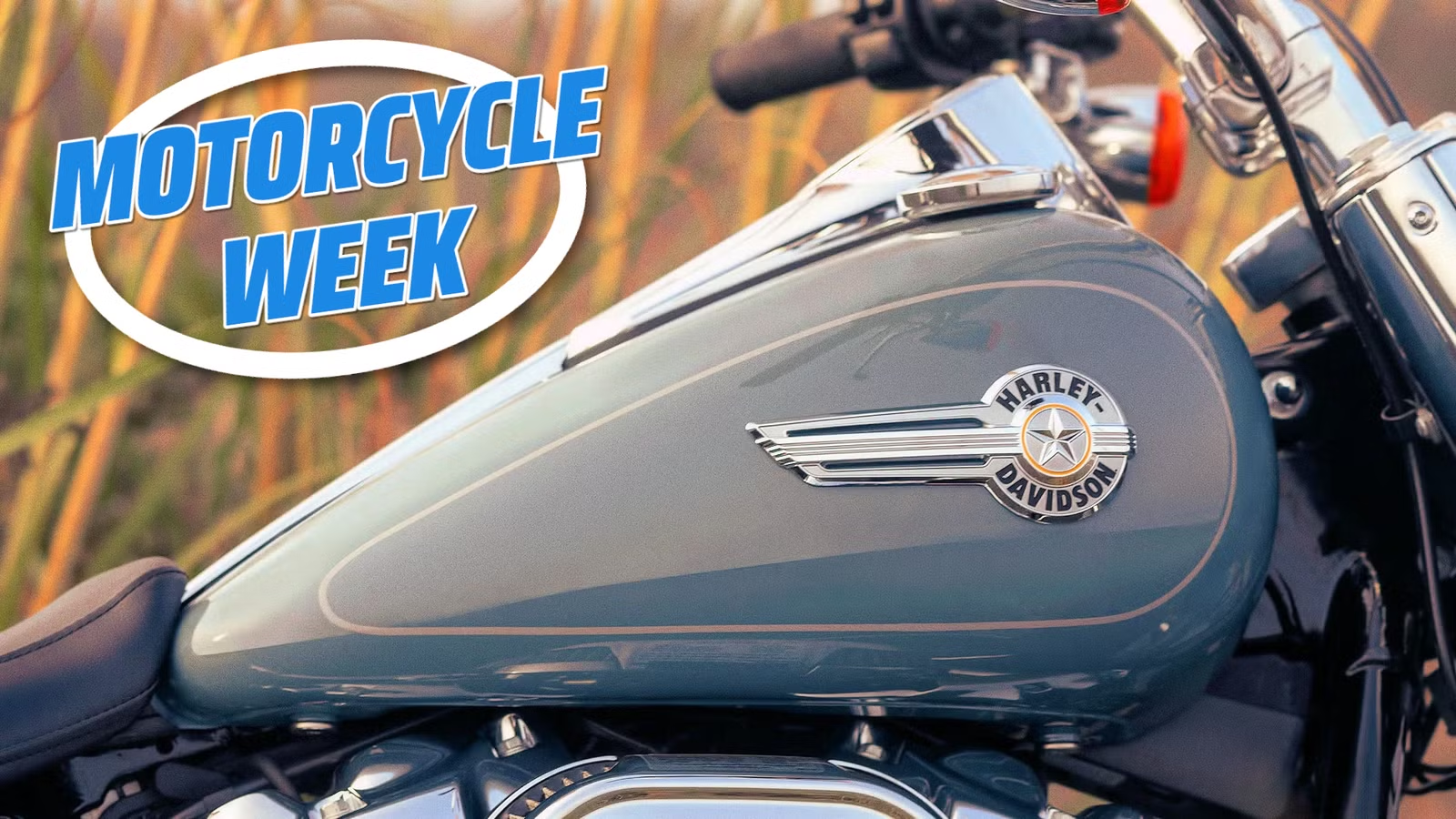
Let’s start with the Harley in question, the Fat Boy, a bike that would be our first pick for running for Oscars. Since its debut back in 1990, this beefy Softail cruiser has ruled the roads and the silver screen. Its steamroller stance defines modern-day cruiser styling, and its appearance in Terminator 2: Judgement Day established its name in pop culture, beyond just the motorcycle circles. Even those who don’t know anything about bikes fell in love with the persona and powerful aesthetic the Fat Boy represented in that movie. The bike essentially pushed the boundaries of what makes a cruiser with its performance and design.
The Hayabusa made its debut nine years after the Fat Boy, and it set the performance precedent so great that many refer to it as the world’s first hyperbike. This guided missile, with its grotesque design and big-bore four-banger engine, set the speed record and forced every sports bike that followed to never cross the 186 MPH mark, at least for some years. And, it became so popular, both in biking culture and beyond, that it represents speed and performance more than any other sports bike out there.
This impact on pop culture is why it’s so easy to club these two motorcycles together, even though they offer experiences that sit on the polar ends of the motorcycling spectrum. The Fat Boy is a chunky cruiser designed for straight-line stability and badass road presence. On the other hand, the Busa is a certified performance beast that still remains among the fastest motorcycles you can buy today. But both bikes have gone through more or less the same arc, rewriting the script for what it means to be a cruiser and a sports bike, respectively.
Often looked at as a decade of stagnation for Harley-Davidson, the 90s still gave us a few noteworthy bikes
Let’s start with the thing that matters the most to motorcyclists: performance. As different as the two bikes may be, they are still groundbreaking when it comes to performance. But both do it in different ways. The Fat Boy has always focused on straight-line stability and gallops of torque that make for unbothered highway cruising. The Busa, on the other hand, focuses on unstressed yet superbike-level performance that can reach speeds of up to 186 miles per hour, electronically limited, of course.
Since the Fat Boy’s debut, it has set the standard for what’s possible with a big twin engine. Of course, more powerful and torquier cruisers exist, but the Fat Boy offers a package that’s rare. It combines its torquey big twin engine with a steamroller stance that keeps the bike planted and stable. In its current generation, the Fat Boy is powered by the Milwaukee-Eight 117 Custom, which produces 126 pound-feet of torque, second only to the Low Rider ST, which makes 2 more pound-feet from its M8 117 H.O. engine. The bike is known for its responsive torque delivery and confident cruising character that you’d expect from a Harley-Davidson.
The Hayabusa, on the other hand, features a big-bore inline-four engine that’s made to set top speed records, at least when it first came out. Back in the ‘90s, the Hayabusa was Suzuki’s halo bike designed to take on the then fastest bike in the world, the Honda Super Blackbird, and it did so by topping out at 194 miles per hour. Its insane top speed forced every manufacturer to cap their bikes at 186 miles per hour, a standard that's still followed by most sports bikes, including the current generation of the Hayabusa.
Taking it a step further, the Busa was so bonkers that even some ‘90s supercars, including Ferraris and Lamborghinis, seemed slow in front of it. The over-engineered engine also allowed custom bike builders to squeeze out 300 to 500 horsepower from it with nothing but a turbo, an ECU update, and some internal upgrades. All while being easy to ride as an everyday sports bike for the average owner. Yes, the current performance apex predator is the Kawasaki Ninja H2, but it still doesn’t blow everyone’s minds quite like the Hayabusa did back then.
The 90s were a decade of speed, and now the fastest motorcycles are up for grabs at unbelievable prices.
A part of the two bikes’ significance is also their design, which matters more than your sensibilities would like you to believe. We buy our bikes for performance, but you can’t deny that there’s an appeal in riding motorcycles that simply look awesome and badass. Plus, their designs help build their character arc further by appealing to not just motorcyclists but the average public that couldn’t care less about motorcycles. They turn their heads to get a glimpse of the Fat Boy and the Hayabusa.
The Fat Boy has gone through significant evolution over the years, but its core design philosophy has remained the same: a low-slung, beefy cruiser with an in-your-face road presence. The Fat Boy is most known for its signature Lakester wheels, which rumors say are inspired by the B-29 aircraft. Then there’s the chrome headlight nacelle sitting atop chunky forks, thick wheels, and muscular metal. The Fat Boy strikes a rare balance in design, combining vintage-inspired, smooth design cues with an imposing road presence that’s hard to ignore.
The Hayabusa’s lead designer wanted the bike to be grotesque and create a strong initial impact, and it does so. The Hayabusa is an unconventional sports bike, featuring smooth lines and a heft that you’d think would impede its performance. Instead, its bulky bodywork is designed in a wind tunnel to slice through the air. A side effect of it is that the design makes the bike unmistakable on the road. Yes, the current-generation Busa has gotten a lot sharper than the first-generation that looked like it was stung by bees, but it still remains unconventional and unique.
You might have forgotten these Harleys in 2025, but they can still make their case against modern-day alternatives
It’s this mix of performance and design, and what the bikes represent, which has brought them into the limelight of the masses, not just motorcycle enthusiasts. People no longer see these bikes as just another two-wheeled automobile on the road. The Fat Boy represents rebellion and power, while the Hayabusa represents the pursuit of speed. Few other motorcycles come close to this level of pop culture relevance, though some excellent examples include the Ducati 916, Honda Super Cub, Kawasaki GPz900R, and perhaps a Vespa scooter.
When director James Cameron and his production team looked for a motorcycle for the T-800 Terminator, the Fat Boy emerged as the ideal choice. The bike’s muscular stance complemented Arnold Schwarzenegger’s commanding screen presence. And this led to one of the most unforgettable moments in motorcycle history: the Fat Boy's appearance in Terminator 2: Judgment Day. In the movie, the Fat Boy wasn’t just a prop; it became a character of its own.
Before the movie, the Fat Boy was known in cruiser circles as a competent touring cruiser, but the movie redefined its cultural significance. The Fat Boy went from being a powerful cruiser to a symbol of rebellion and strength. It instantly created demand for the bike, with dealerships reporting waiting lists stretching months. Moreover, the bike's popularity beyond biking culture shifted public perception of Harley riders from outlaw bikers to cool motorcyclists. Along the way, the Fat Boy made Harley-Davidson a household name around the world.
The Hayabusa is just as strong a cultural phenomenon as the Fat Boy, but it goes beyond just movies. Thanks to the incredible custom scene it helped develop, the Hayabusa became the go-to choice for custom bike builders to show off their skills. At the same time, it became a prop for marketing, with rappers, NBA stars, and even NASCAR joining in on the custom-Busa wagon for marketing. The Hayabusa also got plenty of cameo appearances in movies, music videos, and anime. Think Finish Line, 2 Fast 2 Furious, Biker Boyz, or music videos of Mos Def, Lil Wayne, and Rick Ross.
In one part of the world, India, the Hayabusa did exactly what the Fat Boy did with Terminator 2. This was a time when Indian biking culture was in its nascence, but a 2004 movie, Dhoom, featured the antagonist riding the Hayabusa. Like Schwarzenegger riding the Fat Boy, the Hayabusa became an instant hit. The Busa is one of the reasons why yours truly (me!) got interested in motorcycles. For many years then, the Hayabusa remained synonymous with sports bikes for those who can’t tell the difference between a Ninja and a CBR.
For over 25 years, the Dyna line was part of the Harley-Davidson dynasty
Both the Fat Boy and the Hayabusa also went through three generational updates. The 1990 Fat Boy featured an Evolution engine, followed by the 1999 model getting the Twin Cam 88, 96 and 103, and the current post-2018 crop featuring the Milwaukee-Eight 114, then 117. Similarly, the 1999 Hayabusa was replaced by the sleeker 2008 Busa, followed by the modern and sharp 2022 Hayabusa. Yet over the generations, the bikes have stayed true to their individual philosophies.
The Harley-Davidson Fat Boy commands respect today in the cruiser segment. It may not be the best cruiser out there (have you seen the Ducati Diavel V4?), but it is still relevant. It consistently ranks among Harley-Davidson’s top-three selling motorcycles. And it has helped Harley go beyond its American customer base and its outlaw image problem. Sure, the Terminator may as well have ridden a Triumph Rocket 3, but that wouldn’t have felt quite as right as the Fat Boy. It is the Terminator bike.
Similarly, the Hayabusa was once so groundbreaking that it invited backlash from European regulators who threatened an import ban that led to the Gentlemen’s Agreement. The Hayabusa put an end to the decades-long speed wars, capping every sports bike at 186 miles per hour, except for outliers like the MV Agusta F4 312. Even though it may have lost a bit of its edge in its third generation, it was once ahead of its time and remains among the most important motorcycles ever made.
Found an error? Send it info@www.topspeed.com so it can be corrected.
Source: https://www.topspeed.com/how-two-bikes-opposite-sides-of-world-rewrote-rules/
Cars
Harley Fat Boy vs. Suzuki Hayabusa: How Two Iconic Bikes Rewrote Rules
Article Top Ad Zone
Article Middle Ad Zone
Article Bottom Ad Zone
Original Source: www.topspeed.com
Share
Comments
Comment system is currently disabled.