The video assistant referee (VAR) is one of the most controversial aspects of soccer today. At the 2026 FIFA World Cup, it will again take center stage, providing the final word on many of each match's most controversial calls.
But how exactly does VAR work? What makes it such a divisive technology, and how has it improved (or detracted from) the game? Here's everything you need to know.
Andy Davies (@andydaviesref) is a former Select Group referee, with more than 12 seasons on the elite list, working across the Premier League and Championship. With extensive experience at the elite level, he has operated within the VAR space in the Premier League and offers a unique insight into the processes, rationale and protocols that are delivered on a Premier League matchday.
VAR is technology that was introduced to support the on-field refereeing team when they have not seen (or were unable to see) an important piece of information, resulting in a clear error being made in a key decision. VAR technology allows the referee the opportunity to review video footage and decide whether they or his team had made an error in their real-time decision. The original decision can then be changed, and the correct outcome reached.
The VAR team watches every moment of every game. When a potentially significant incident happens, the team checks the footage and replays automatically. If the VAR believes a clear error has been made, they alert the referee and recommend that the referee goes to a pitchside monitor to review and make the final call from the replays.
If it involves a factual decision -- i.e., if a foul has occurred inside the penalty area, but the referee believes it was outside -- this information will be fed in by the VAR as factual error, and the referee will change his original decision without having to rewatch the incident.
The VAR is linked up to the referee, assistant referees and the fourth official via an advanced communication kit and can contact them individually or as a team of four.
VAR can only get involved in potentially game-changing moments. Before this World Cup, VAR could only get involved in four areas of the game:
- Goals: offside, handball, or a foul in the build-up - Penalties: whether one should or shouldn't have been given, and whether it was inside the box - Red cards: serious foul play, violent conduct, denying an obvious goal-scoring opportunity, or abusive behavior - Mistaken identity: if the referee booked or sent off the wrong player
However, for the first time, the 2026 World Cup will see two additional situations where it can intervene:
- Corner kicks: if it believes a corner kick has been awarded incorrectly - Second yellow cards: If a player receives one that, after review, is judged to be an incorrect decision by the referee
Any other decision made by the referee cannot be reviewed by VAR.
When a goal is scored and there is a potential offside offense in the buildup, SAOT technology is used. SAOT uses up to 30 cameras (separate to the VAR cameras) -- some shooting at twice the normal frame rate. The system automatically detects offside positions and generates 3D graphics to show the decision. It has made offside checks significantly faster and more accurate.
"Clear and obvious" is terminology you will hear spoken about a lot when discussing VAR.
The VAR can only assist the referee in the event of a "clear and obvious error" or a serious missed incident. The original on-field decision cannot be changed unless the video review clearly demonstrates this threshold has been met.
This bar is deliberately set high: the "referee's call" principle means that if a subjective decision is genuinely debatable, the on-field referee's original call should stand. In practice, it means VAR should not intervene simply because a decision could have gone the other way -- VAR will become involved only when there is little or no doubt that the referee has made an error.
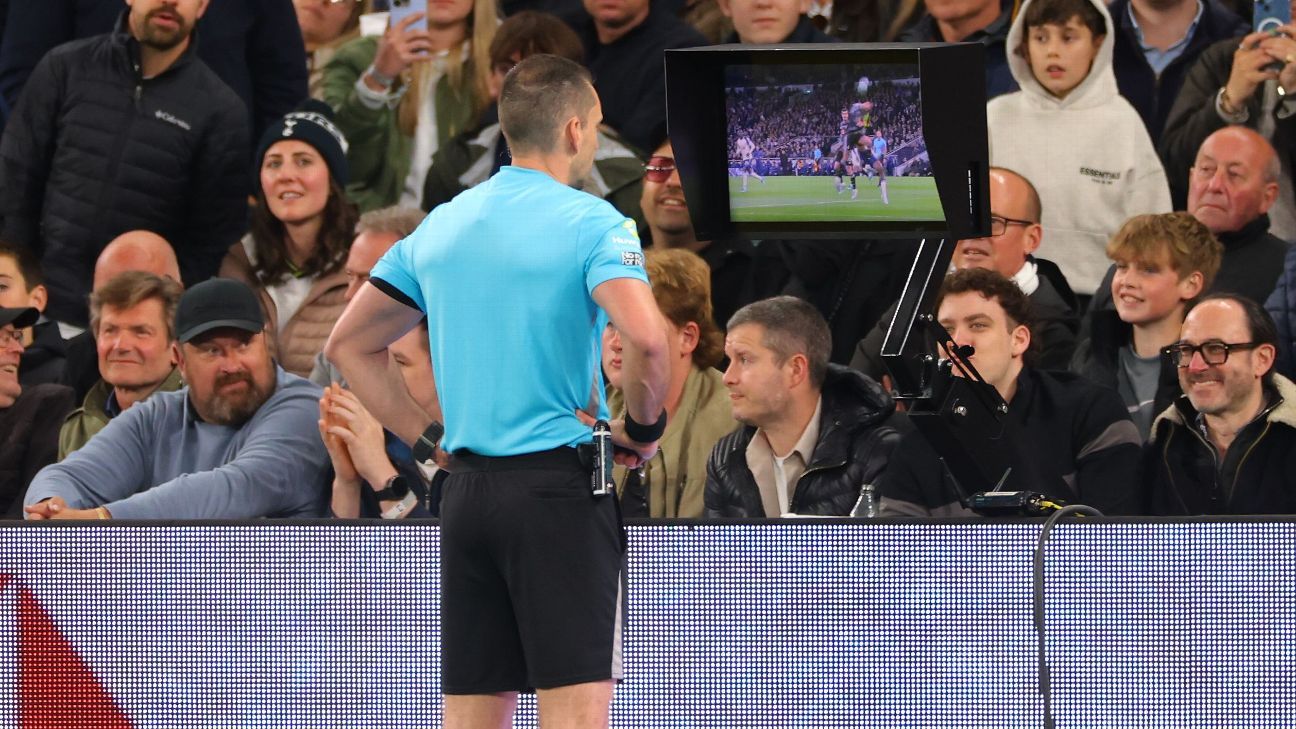
When the VAR believes that the referee has made a clear error in his subjective on-field decision, he recommends the referee look again at the replays on a pitchside monitor -- this is called an on-field review. The referee goes to the touchline to watch the replay directly on a pitchside screen before making a different decision, or confirming their final, original decision.
Aside from offside decisions, which are factual, all subjective VAR decisions are ultimately decided by the on-field referee only.
If called to review the pitchside monitor by VAR, the referee has complete autonomy to decide on what the next decision and potential discipline sanction will be. He can even reverse his original decision and ignore the VAR's recommendation and completely flip the decision in its entirety -- however, this is unlikely.
Most on-field reviews (OFRs) result in the referee changing their original decision or discipline sanctions (i.e. upgrading a yellow card to a red card), having been afforded the opportunity to watch the replays from a different angle or in slow motion. This is because it very rare that the VAR would recommend that the referee review their original decision unless they are very confident that an error has been made in real time.
However, it does happen. Penalties for handball, given or not given, and possible red-card tackles are the types of subjective situations where the referee, having rewatched the replays, sometimes believes that their judgment in real time was a correct call and sticks with their original decision. The VAR is encouraged not to intervene unless the replays show a completely different story to the one the on-field referee believed they saw or described at the time.
A check happens automatically and constantly. The VAR monitors all play and checks every incident that could fall into the six reviewable categories. Most checks result in no action -- the VAR confirms the referee's decision was correct and play moves on, often without the public even noticing.
A review is a more formal process, triggered when the VAR believes there might be a clear and obvious error. The referee is informed, play might be paused, and footage is examined in greater detail. A review can either lead to the referee's original decision being upheld or changed.
If, having completed a check, the VAR believes that an on-field error has occurred by the refereeing team and play is still ongoing, the VAR will inform the referee that an OFR is being recommended. The referee will then use his judgement to stop play either the next opportunity the ball is dead, or when the ball is in a neutral area on the pitch as to cause the least disruption to the game as possible.
VAR was introduced to get more of the game-changing decisions correct. Unfortunately, sometimes these situations can be complex, requiring several elements of the action to be broken down in chronological order, and each one debated and judged. Sometimes this can be frustrating for supporters. However, stakeholders and authorities have agreed that if a review takes four minutes and the correct outcome is ultimately reached, that should always override a quicker process and an incorrect call.
Once the referee has reviewed an incident on the pitchside monitor, they have complete freedom to do whatever they feel is necessary to correct the original decision. This can include producing or rescinding a red or yellow card, overturning a penalty decision, or reversing an incorrectly awarded free kick.
VAR was bought in to make football fairer, and the data shows that this is the case, with more key match and game-changing decisions acknowledged as correct via the VAR system. The technology helps correct clear and obvious errors in goals, handballs, penalties and offsides, preventing injustices that could significantly impact the outcome of matches.
Below is an overview of the good and bad impacts of VAR.
-- Significant errors -- the kind that used to change the outcome of games unfairly -- get corrected -- Accusations of referee bias toward bigger teams have reduced, since decisions can be verified objectively -- Player discipline has improved, as players know incidents are being watched closely -- Accuracy is improving -- most VAR interventions in recent seasons have been correct, and the number of errors is falling year on year both at international and domestic level
-- It can disrupt the flow and spontaneity of the game: goal celebrations are routinely held back while everyone waits to check if the goal will stand -- It hasn't removed subjectivity: Handballs and penalties can still be interpreted differently by different officials, though this is now more consistent -- Confusion as things are happening: Some goals have been ruled out by margins so fine that they're barely visible to the naked eye, leaving fans struggling to understand certain decisions -- Errors still happen, sometimes high-profile ones: The system is not perfect, but soccer is a subjective sport, so VAR can never be perfect -- Declining excitement: Most fans surveyed say VAR can make watching matches less enjoyable
Source: https://www.espn.com/soccer/story/_/id/48884187/var-explained-former-referee-2026-fifa-world-cup-how-works
Football
VAR explained by former referee: How will it work ...
Article Top Ad Zone
Article Middle Ad Zone
Article Bottom Ad Zone
Original Source: www.espn.com
Share
Comments
Comment system is currently disabled.