James OlleyMay 20, 2026, 08:00 AM ETCloseJames Olley is a senior soccer writer for ESPN.com. Read his archive here and follow him on Twitter: @JamesOlley.
On a wall at Arsenal's training ground is a large silhouette of the Premier League trophy alongside a message which reads: "Together We Make History." It was installed earlier in Mikel Arteta's reign as manager, ready to be illuminated when the Gunners eventually won the title. And now, finally, Arteta has dragged Arsenal from the darkness back into the light.
Manchester City's 1-1 draw at AFC Bournemouth on Tuesday sealed the Gunners' 14th championship, their first in 22 years. Players and staff assembled to watch the game not too far from that silhouette, and the final whistle sparked euphoric celebrations, running into the early hours of Wednesday. Several players including Declan Rice and Bukayo Saka were pictured outside Emirates Stadium at 5 a.m.. The club dog, Win, was given a stuffed toy in the shape of a champagne bottle.
It is both a landmark moment in the club's history and the culmination of a plan hatched in 2019. Football is awash with strategies for success, but so few come to fruition. It is why those who deliver on these blueprints are written into folklore: think Jürgen Klopp ending Liverpool's 30-year wait for a league title, as he predicted in his opening news conference, or José Mourinho proving he really was "a special one" upon arriving at Chelsea in 2004.
Arteta can now join this list of clairvoyants, the select few who backed up their talk with tangible returns. Not that he was ever outspoken about his approach.
- After 8,060-day drought, Arsenal are deserved Premier League champions - Arteta's Arsenal finally win title after so many near-misses - Arsenal unveil new home kit ahead of Champions League final
The "five-phase plan" Arteta proposed alongside then-technical director Edu Gaspar six years ago has been shrouded in secrecy. Whenever he was asked about it, the Spaniard would usually offer up the briefest glimpse into his thinking. Less than two weeks ago, before Arsenal edged past West Ham United 1-0 at London Stadium, he dodged questions about it entirely.
However, for the first time, ESPN can reveal the methodology by which Arsenal transformed themselves from a broken club in 10th place into title-winners who are now one game away from their first UEFA Champions League crown.
Edu is steeped in Arsenal history, having won two Premier League titles as a player between 2001 and 2005 -- including the fabled "Invincibles" season when the Gunners won the 2003-04 title without losing a league game -- before rejoining the club as their first-ever technical director in July 2019. At that time, Unai Emery was beginning his second season as head coach after succeeding Arsène Wenger. But the dressing room fractured, results suffered and he was sacked in November of that year. Arteta was appointed a month later.
Speaking exclusively to ESPN, Edu discussed the origins and development of Arsenal's five-phase plan for glory, approved by owners Kroenke Sports Enterprises, led by Stan Kroenke and his son Josh.
"I arrived five months before Mikel and put in place a five-year plan with my idea that I presented to Josh and Mr. Kroenke what I thought we should do in those five years," the Brazilian, who is now the Global Head of Football at Nottingham Forest, tells ESPN. "Unai Emery was our coach in that period and, honestly, I wasn't sure if Unai would be the coach to run with me the project over five years.
"I said to him and Raul [Sanllehi] -- who was head of football -- 'let's go to the journey, let's put that plan in place with Unai and see if we can make it.' They said 'OK, let's do it.'
"Then in those five months, I saw things I didn't really like, the way we started to go in the direction of the club with Unai. We recommended to Mr. Kroenke and to Raul to change [coach]. They accepted and then I met Mikel. I spoke to him on the phone first of all, to see if he's available [Arteta was working as a coach under Pep Guardiola at Manchester City at the time], the typical approach to see things. In that call, my first call with Mikel, I don't know how and why, we started an unbelievable relationship without knowing each other.
"We stayed an hour talking on the phone, like friends, not talking about football. And then he said 'OK, Edu, I want to be available.' Then I said 'let's talk, let's organize a meeting.' We did that and then I presented to him the plan about the squad, the five-year plan and blah blah blah and he presented to me his plan as well.
"The plans together made a lot of sense, in terms of how we look at the future. Then we adjusted between each other and put one plan together. As you see the plan is probably working the way we expected."
"The first was 'clean the squad and bring some players with the mentality that we believe is correct for the plan,'" Edu says. "And with that, we said we need to find the core of the team. We started to balance the squad and help us to go again, again and again. It would be impossible to change all the squad in one season or one window or two windows."
Large-scale changes took place behind the scenes. The club's scouting system was overhauled and a new football leadership team was created. Over time, this included Edu, Arteta, Tim Lewis, James Ellis, Richard Garlick and James King, all reporting into the Kroenkes with Josh an increasingly prominent presence.
Arsenal won the 2020 FA Cup in Arteta's first season. He was promoted from "head coach" to "manager" -- a change he did not ask for, but one which reflected the faith they had in a young boss impressing in his first managerial role.
Perhaps the most significant show of support, however, was in the club's ruthless approach to culling the squad. There were serious concerns about the dressing-room culture and a drop in standards which could only be properly addressed through a drastic overhaul of the players.
Pierre-Emerick Aubameyang -- who was also stripped of the captaincy -- Mesut Özil, Henrikh Mkhitaryan, Sokratis Papastathopoulos, Shkodran Mustafi, Sead Kolasinac, Willian and Héctor Bellerín had their contracts ripped up and paid off, in some cases receiving the vast majority of their money to leave immediately. Club-record signing Nicolas Pépé would later follow. Sources close to the Kroenkes describe the period as "brutal."
"Can you imagine we say 'we have to pay some money to some players to leave because they don't have a market?'" Edu says. "What happened in that period, some players had a contract, they were over 27, 28 years old with big salaries and don't play much. How can you sell players like this? You cannot sell.
"But you need to move these players because some of them were blocking the progression of the project. You also have to convince the owners this can be in the future an investment -- can you imagine? We say 'you have to pay money but in the future you are going to see the result of it.' 100% honestly, the way they approached this situation to me and Mikel, they said 'go for it, you have all my support to do it.'"
The club entered phase two accelerating their changing approach to transfers. With Lewis on board, Arsenal moved out Sanellhi and focused their efforts on signing players under the age of 24 for smaller fees.
Arteta himself arrived at Arsenal as a player from Everton in the summer of 2011 on deadline day as the club signed five players at the 11th hour to rescue a poor transfer window. He, more than anyone, knew the deep-rooted issues.
Arsenal were one of the first clubs to fully integrate an in-house data analysis company -- StatDNA, originally based in Chicago -- in late 2012 but the use of analytics was "recalibrated," according to sources.
"We have to be better as a squad, much stronger to compete properly," Edu says. "Also financially, we were in this stage to bring in top, top players. Then we should be very smart, very strong to bring the best players possible with the mentality we should go for.
"What is very interesting was that, when we said to 'trust the process' and people started to make fun of it, we planned in the first two years not even to be in the Champions League spots because we were very realistic in terms of how difficult it would be to change the squad, to change the dynamic, to put some culture, to follow the strategy, to bring some new players.
"I said, and [Arteta] said as well, we need some time to build properly. We said after the third season together, we believed we are going to be very strong and are going to be fighting for the league, for the Champions League and we're going to be fine. But we said to the Kroenkes, we need the support, patience and belief, and leave it to us to run the plan together."
Don Hutchison credits Mikel Arteta and Arsenal's recruitment for their Premier League title win.
That patience was tested during this period. The club finished both the 2019-20 and 2020-21 campaigns in eighth place, but spending began to accelerate.
COVID-19 and the failed European Super League breakaway (of which Arsenal were a part) created a turbulent financial backdrop for many clubs. But Ben White, Martin Ødegaard and Aaron Ramsdale arrived at the Emirates in the summer of 2021, while the emergence of Emile Smith Rowe and, in particular, Saka ensured the club's Hale End academy was helping to fill the void of past exits and create a genuine sense of togetherness within the group.
However, Arteta's functional football and mixed results tested supporters' resolve. It has long been speculated that the slow return of fans to stadiums as COVID-19 restrictions were phased out may have helped save Arteta's job. It is a question he has always avoided answering.
But bonds were being forged. Today, some of the players -- Kai Havertz and club captain Ødgeaard, for example, have taken vacations together, while there is a group including Noni Madueke, Jurriën Timber and Eberechi Eze who have a strong connection through their Christian faith. Parchís, a Spanish board game, is regularly played while travelling to and from away matches.
A young team with a genuine affinity for each other saw the club grow together. And Arsenal moved into phase three after narrowly missing out on Champions League football in 2022-23.
"Phase three was to start to add more quality players -- Gabriel Jesus, Oleksandr Zinchenko -- which had quality to put us as a different level [but also] players with Premier League experience, a good mindset who are used to winning things, used to big finals and they can implement their mentality in the dressing room," Edu says.
Jesus and Zinchenko arrived for a combined fee of around £75 million from Manchester City, where they had won four league titles, three League Cups and one FA Cup together (Zinchenko had an extra Carabao Cup success, just for good measure). Jorginho, meanwhile, was snapped up for £12 million from Chelsea as a Champions League, Europa League and FIFA Club World Cup winner.
The leap forward was significant. Arsenal challenged for the Premier League title until running out of steam in March and April, as a squad short on depth faltered against perennial heavyweights Manchester City. Squad depth was still an issue, as was physicality.
Again, Arteta had lived through years of regular criticism that Arsenal habitually lacked the requisite fight, durability and leadership on the field to succeed at the top level. For years, Wenger repeatedly fended off questions about the weakness of central midfield. Many who hark back to the days of Patrick Vieira and Roy Keane defining the biggest games for Arsenal and Manchester United in the 1990s and 2000s argue neither player has ever properly been replaced.
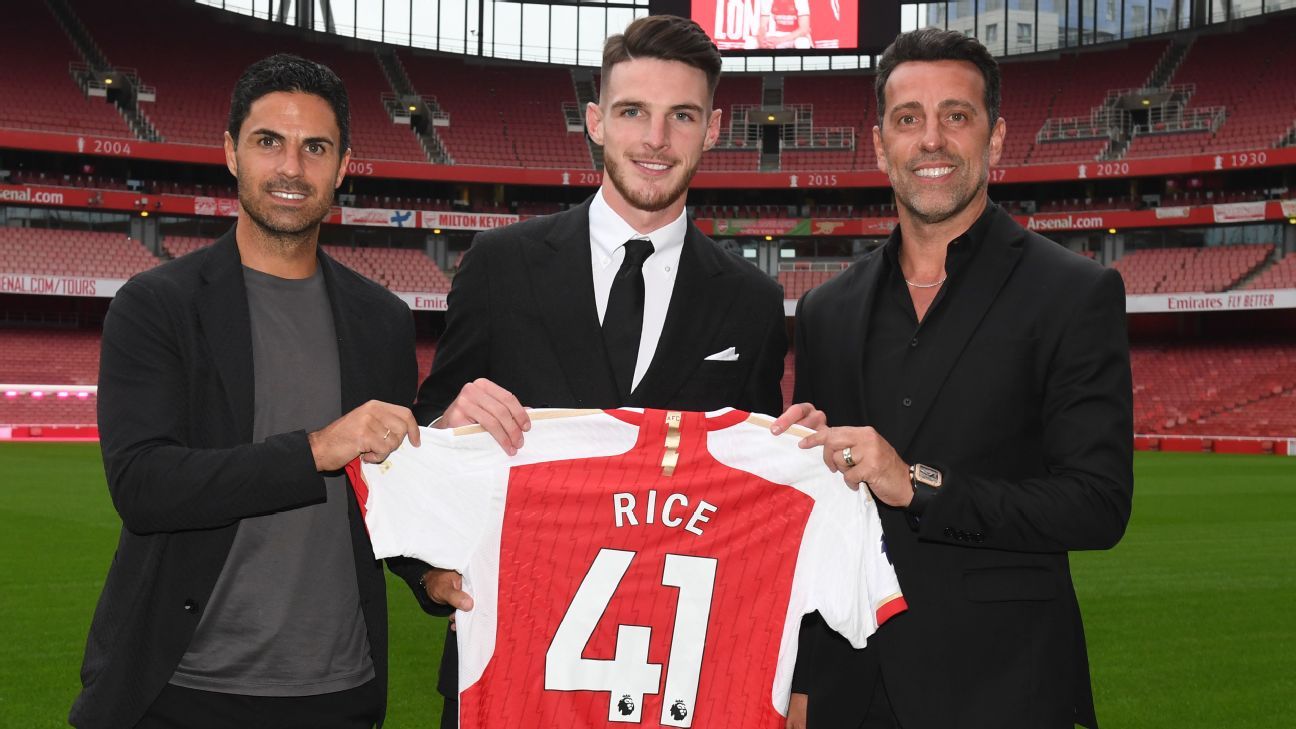
Cue phase four, which Edu summed up in three words: "Bring Declan Rice."
Was it really that simple? "I remember it exactly the way I'm going to explain to you," he continued, referencing Arsenal smashing their transfer record to sign Rice from West Ham United for a fee of £105 million in July 2023.
"We said 'we need a top, top English player who has a good reputation everywhere: in the press, in the clubs, in every aspect, to give some more credibility to English football. Because we are a club in England and we need to have the best English players in our squad, like Bukayo [Saka].
"We needed someone to impact properly and make sure that player is going to be with us for 10 years. It is not just in terms 'let's bring the player here and sell the player.' No. Let's invest in the player and run the process with us to make a difference.
"Then we had Kai Havertz, all the names, and our squad started to become very strong. If we are going to be fighting for the league and Champions League, we need a better squad, not just 11, 12 or 13 players. How are we going to build a bigger squad and better squad to give Mikel more tools to be flexible in what he wants to do."
Dominant in defence and on set pieces, take a look at the key numbers behind Arsenal's Premier League title win.
Rice, Havertz, Timber and goalkeeper David Raya (initially on loan from Brentford) were the headline arrivals in another heavy summer spend.
Some questioned the size of Rice's transfer fee at the time, but Edu says: "We were so sure about it because we said no price is going to stop us to buy this player."
Meanwhile, Arteta continued his obsessive search for marginal gains. One of the Spaniard's ideas was to bring in Win, a chocolate Labrador and trained therapy dog, to foster more togetherness. An olive tree was planted in the grounds to symbolize the importance of daily maintenance.
Arteta also carried on innovating in his team talks and training methods, once using a washing machine in front of the players to explain the difficulty of playing Liverpool at Anfield. This season, that continued by lighting a fire at the training ground and asking players to "throw" any negative feelings into it as the pressure of the run-in intensified.
But in 2023-24, the transfer spending didn't yield immediate returns. Arsenal finished second again in the league as City amassed 91 points while the Gunners reached the Champions League quarterfinals, but their wait for a trophy continued. A year later, they were second once more, this time to Liverpool, but the support from the ownership remained.
"I don't think sometimes Mr. Kroenke and Josh Kroenke get the credit they deserve to be fair," Edu says. "I can promise you for my family, always when I presented to them a plan of a window, what to do, how to do, what to sell and buy, because we present properly to them. Me and Mikel never just talked to them, we explained to them, we give reasons to them and honestly I never received one 'no.'"
Edu left Arsenal in November 2024 and was replaced by former Atletico Madrid chief Andrea Berta, whose first summer window was dramatic. Arsenal invested heavily again, spending more than £250 million to bring in eight summer signings including Viktor Gyökeres, Martín Zubimendi, Eze, Madueke and Piero Hincapié (initially on loan).
Arteta's desire to leave no stone unturned in pursuit of success reached new levels. Sources have told ESPN that his intensity could occasionally alarm some at the club but those marginal gains have added up a historic league win.
There was concern at the club's disciplinary record, with Arteta frustrated at red cards costing them vital points in the 2024-25 season. Today, they are the only Premier League team without a dismissal this season and have also not conceded a penalty.
Set pieces have been a potent weapon. Arsenal are not as dynamic as City from open play but their dead-ball ability is unsurpassed. Eighteen of their 69 league goals have come from corners. The margins have been fine: They have won 11 games 1-0 in all competitions, including their last three matches.
This month, Arteta has organized barbecues at the training ground to ease the pressure while unusual sessions including balancing balls between players' heads and holding marker pens in the air attracted split external opinions. But this time, despite all the talk of 'bottle,' inexperience and facing the relentless juggernaut that is City under Guardiola, Arsenal have finished on top.
And this is where phases four and five began to blur. "Four and five is winning," Edu says. "We had to get to the moment to start to win things. We were very close [in my time there], two leagues in a row. We lost some momentum at the end of the season, but we were very close to win the leagues."
"Phase five is to be consistently there in the Champions League, winning leagues, bringing trophies [to the club.]
"I am still supporting the club. My family here, everybody is celebrating to see their success. Everything that is there, I feel part of it. With all the respect because I know Andrea is there. But I feel a lot of my work is there.
"And for me, Mikel is going to be one of the best coaches in the world if he's not today. We have Pep [Guardiola], Luis Enrique, but for sure he is one of the top-three best managers in the world and he is going to be the best one very soon. No doubt. Because the way he thinks, the way he behaves, I know that with even more experience, he will for sure be one of the best."
Source: https://www.espn.com/soccer/story/_/id/48823578/inside-arsenal-five-phase-plan-win-premier-league-title-mikel-arteta-edu
Football
'Trust the process': Inside Arsenal's five-phase p...
Article Top Ad Zone
Article Middle Ad Zone
Article Bottom Ad Zone
Original Source: www.espn.com
Share
Comments
Comment system is currently disabled.