When detectives searched Peter Murrell and Nicola Sturgeon's home on the outskirts of Glasgow in April 2023, one image dominated the news coverage.
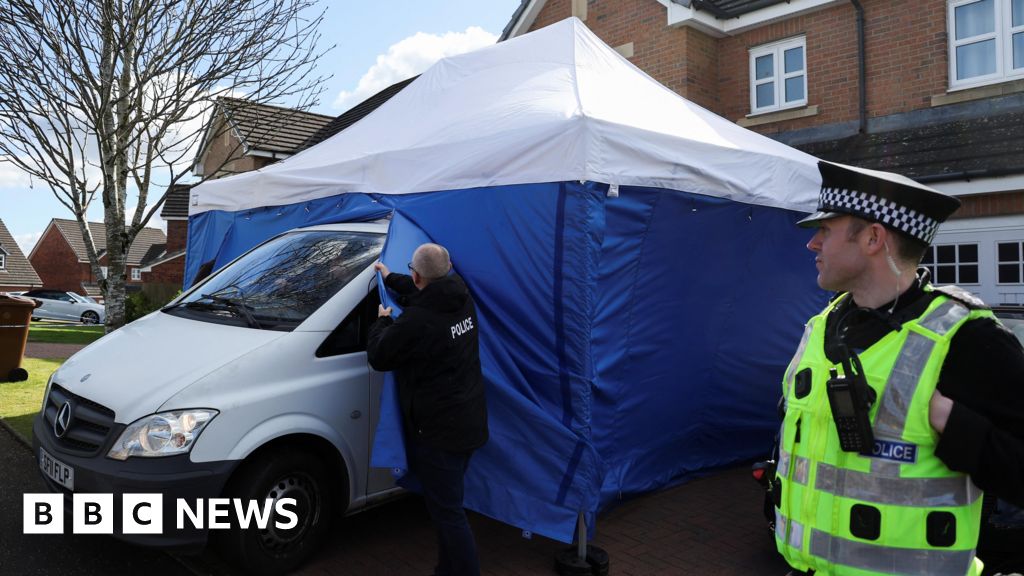
A large blue and white police tent had been pitched on their front garden, blocking views of the front door and leaving the house looking like a crime scene.
One former SNP head of communications claimed "a routine process" had been turned into a "grotesque spectacle". Another senior party figure described the operation as "heavy handed" and "completely over the top".
Stung by the criticism, Police Scotland said their actions had been "proportionate and necessary".
The most controversial tent in Scottish policing history was set up outside the couple's house because officers wanted to examine, log and seize some of their possessions.
They suspected they had been purchased with cash embezzled from the SNP, and didn't want their every move filmed and photographed by the media standing outside.
A source with inside knowledge of the investigation told BBC Scotland News that the evidence against Murrell had become "overwhelming".
"This was SNP money, SNP accounts, SNP credit cards, used privately for the benefit of an individual.
"That's why the tent was there, because it was so incredibly excessive. There were multiple items. It's scandalous."
The source said the investigation had started after police received an allegation of fraud.
"It took a very long time to get the material that we needed to find out what was going on," they added.
"It was only through painstaking, dogged work by detectives and forensic accountants that the embezzlement was revealed.
"The people who were the most critical were the ones who should have been the most angry. It was their money that was getting taken."
Two years on, Murrell has admitted the home he shared with Scotland's former first minister was indeed a crime scene.
It was one of more than 20 locations where he abused his position as party boss, spent more than £400,000 of SNP cash and fiddled the books afterwards.
Such a breathtaking breach of trust conducted over more than 12 years means a lengthy prison sentence looks inevitable, even if it is reduced because of his guilty plea.
Operation Branchform - the name chosen at random - was the most politically sensitive investigation carried out in Scotland since detectives looked into sexual abuse allegations against the late Alex Salmond.
The former SNP leader and first minister was cleared after standing trial in 2020 - and that must have been on the minds of police and prosecutors when they began investigating the party's finances in the summer of 2021.
The inquiry was launched after members of the public asked what had happened to £670,000 raised for a campaign for a second referendum on Scottish independence.
Based at the Scottish Crime Campus at Gartcosh, the team of detectives went on to discover that Murrell had used cash donated by SNP supporters to buy goods worth £139,971.00 from more than 90 retailers all of it for his "own personal use or the personal use of others".
On the day of his arrest on 5 April 2023, police seized a £124,550 luxury motorhome parked outside Murrell's mother's house in Dunfermline.
The German manufacturers, Niesmann and Bischoff, advertise the Smove 7.4e as "breaking all the rules".
Detectives established Murrell had bought it with party cash and covered his tracks with false entries in the SNP's accounts.
He did the same when he purchased a Jaguar I-Pace and kept the proceeds when he later sold the car.
The search at the couple's home and the seizure of the motorhome had been co-ordinated with a raid on the SNP's headquarters off the Royal Mile in Edinburgh.
Officers trooped out of the building with crates of potential evidence; arguably an even more astonishing sight than the tent outside the house near Glasgow.
As the case dragged on and the flak kept coming, Police Scotland's then chief constable Sir Iain Livingstone said their "diligent, thorough and proportionate" criminal inquiry was looking at potential embezzlement.
He told the Scottish Police Authority: "Decisions are and will be based on public safety and the rule of law - not politics or any constitutional position.
"Wholly inaccurate assertions and uninformed speculation will only serve to damage justice, infringe the rights of individuals and undermine the rule of law."
Major financial investigations always take time.
A huge amount of information had to be sought and obtained from financial institutions, retailers and the SNP.
Records of purchases were cross-checked against the party's accounts.
Insiders say that task was made all the more difficult by the great care Murrell had taken to disguise what he was doing from the SNP's auditors, officials and elected representatives.
Scotland's prosecution service, the Crown Office, advised the police throughout and went through their final report on the case line by line, as they decided whether to move against the man who ran Scotland's party of government for 22 years.
The head of the Crown Office, the Lord Advocate Dorothy Bain KC, had been a member of the Scottish cabinet alongside SNP ministers, including Nicola Sturgeon, and took no part in the decision-making process for that reason.
A former Crown Office chief executive, Catherine Dyer, explained: "Our whole system in Scotland is predicated on fairness.
"The Lord Advocate is completely independent, as are all the prosecutors that work for her in making these decisions.
"They will not be influenced. They don't show fear or favour. It's solely based on the evidence."
Sturgeon and the party's former treasurer Colin Beattie were both arrested and questioned in 2023 and remained under investigation until March 2025, when they were informed they were in the clear.
A private memo sent from Dorothy Bain to First Minister John Swinney at the time sheds more light on that part of this tangled tale.
She told him: "Nicola Sturgeon MSP and Colin Beattie MSP were not reported to the procurator fiscal for prosecution.
"Crown counsel [senior Crown Office lawyers] have considered the police request for advice in relation to them and consider the police were right not to report them for prosecution."
When it emerged that the Lord Advocate had given Swinney important information on the case many months before it became public, including the scale of the embezzlement, opposition parties at Holyrood were furious.
They also cried foul when a preliminary hearing was postponed until after the Holyrood elections, following the Sun newspaper's publication of the indictment against Murrell.
Sources told the BBC that the postponement was already under discussion by then.
The defence was seeking more time to consider their position - no surprise in such a complex case - and the delay wasn't opposed by the prosecution.
Who knows what would have happened had Murrell admitted his guilt before voters went to the polls.
Undeniably, the victims in this case are the SNP and its supporters, whose money was pilfered from the party coffers.
There will be searching questions about how such an audacious crime could have gone unnoticed and unchecked for more than a decade, and vindication for the detectives who decided they needed that tent.
Source: https://www.bbc.com/news/articles/cy02dv492njo?at_medium=RSS&at_campaign=rss
World
The painstaking work to uncover Peter Murrell's crimes
Article Top Ad Zone
Article Middle Ad Zone
Article Bottom Ad Zone
Original Source: www.bbc.com
Share
Comments
Comment system is currently disabled.