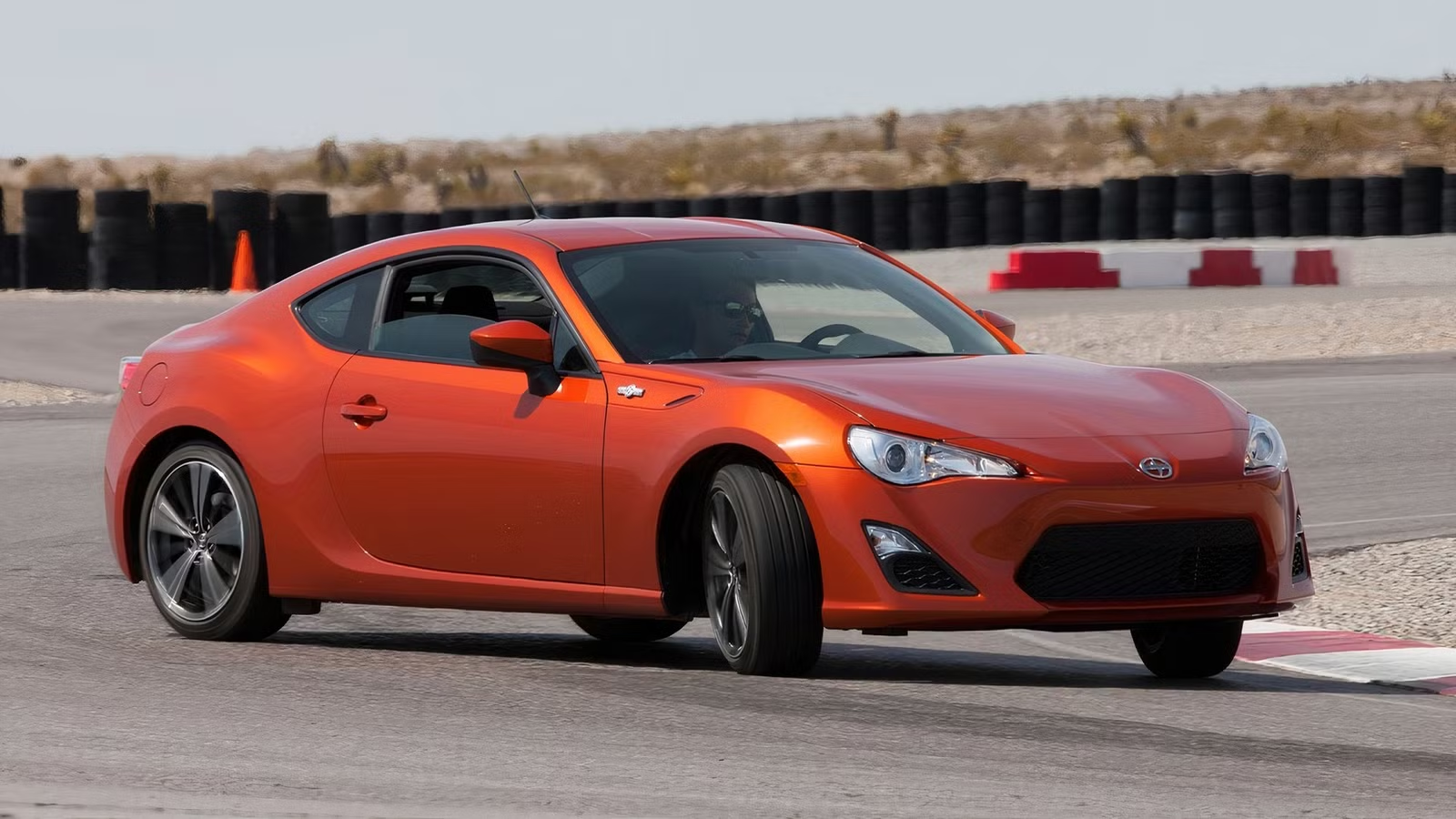
For decades, the Mazda MX-5 Miata held an almost untouchable position among affordable enthusiast cars. It was light, rear-wheel drive, simple to maintain, and endlessly entertaining at reasonable speeds. But in the early 2010s, something unusual happened. A compact Japanese coupe arrived with a similarly obsessive focus on balance and driver engagement, yet it offered more practicality, more rigidity, and a distinctly different personality. That car was the Scion FR-S.
Follow and Like top authors, topics, and trends
Browse with fewer ads across the site
Personalize your profile to showcase your activity
Get a content feed tailored to your interests
By creating an account, you agree to our Terms of Use and Privacy Policy. You also agree to receive our newsletters; you can unsubscribe any time.
*Required: 8 chars, 1 capital letter, 1 number
With a naturally aspirated boxer engine, a close-ratio six-speed manual, a curb weight under 2,800 pounds, and near-perfect balance, the FR-S became the affordable driver’s car many enthusiasts didn’t realize they were missing. More importantly, it forced Miata fans to confront a difficult question: was the better enthusiast car now a coupe?
Modern performance cars have become astonishingly fast, but many have also become increasingly detached from the driving experience that enthusiasts once valued most. Turbocharging, electrification, oversized wheels, and growing curb weights have transformed the affordable sports car market into something far more complicated. That's precisely why the FR-S mattered.
When the FR-S debuted for the 2013 model year, it arrived with a philosophy that already felt old-school. Instead of chasing horsepower figures, Toyota and Subaru focused on low weight, low center of gravity, and steering feel. The result was a car weighing roughly 2,758 pounds in manual form while producing 200 horsepower and 151 pound-feet of torque at 6400 rpm from a naturally aspirated 2.0-liter flat-four engine. Today, numbers like that sound modest. But the engineering priorities behind them are what made the car special.
Many current affordable performance cars now exceed 3,300 pounds while relying heavily on turbocharged torque to create excitement. The FR-S instead rewarded commitment. Drivers had to carry speed through corners, work the gearbox aggressively, and maintain momentum. That interaction created a level of engagement that many newer performance cars struggle to replicate. The industry has also shifted away from compact rear-wheel-drive platforms. Strict emissions regulations, safety requirements, and consumer demand for crossovers have made lightweight enthusiast cars increasingly difficult to justify financially. The FR-S emerged during one of the final moments when automakers were still willing to build a relatively inexpensive sports coupe designed primarily for enthusiasts rather than mass-market buyers.
Even the pricing reflected that mission. The FR-S launched with a starting MSRP of around $24,500 in the United States, making it attainable for younger buyers who previously gravitated toward used sports cars. That accessibility helped the FR-S earn a loyal following almost immediately.
Discover the unexpected choice that blends sporty performance with everyday practicality, redefining affordable driving.
The brilliance of the 2013 Scion FR-S was not hidden in a single standout feature. Instead, it came from the way every component worked together. Toyota and Subaru engineered the platform around simplicity and balance. The chassis rode on a 101.2-inch wheelbase and used a front MacPherson strut suspension paired with a rear double-wishbone setup. That configuration gave the car sharp turn-in response while still maintaining predictable rear-end behavior at the limit.
The boxer engine layout also played a critical role. Because the flat-four engine sat low in the chassis, the FR-S achieved an exceptionally low center of gravity. Toyota claimed it was lower than many exotic sports cars of the era. That low-slung mass dramatically reduced body roll and improved transitional handling.
Unlike many modern sports cars that isolate drivers from the road, the FR-S constantly communicated what the chassis was doing. The steering was quick and direct. The suspension allowed enough movement to keep the car playful. The narrow factory tires intentionally sacrificed outright grip to encourage controllable oversteer and progressive handling characteristics. Enthusiasts immediately understood the appeal. The FR-S also benefited from its minimalist cabin design. There were no drive-mode gimmicks, fake engine noises, or overly complex interfaces distracting from the driving experience. The dashboard is centered around visibility, seating position, and ergonomics.
Critics sometimes complained about the hard plastics and basic interior materials, but that criticism missed the point entirely. The FR-S wasn’t trying to imitate luxury coupes. It existed to maximize driving enjoyment per dollar.
That philosophy is largely why the car developed such a devoted cult following. The aftermarket scene exploded almost immediately as owners embraced the FR-S as a blank canvas for track use, canyon driving, drifting, and autocross competition. Yet even in completely stock form, the car possessed a playful personality that made ordinary roads entertaining.
This British sports car may not have the same level of clout as the equivalent Porsche, but the way it drives will steal your heart.
The Miata had long been considered the gold standard for affordable handling purity. Its lightweight roadster layout delivered incredible communication and balance, particularly on twisty roads where outright power mattered less than agility. But the FR-S challenged that formula in several important ways. First, the coupe body gave the FR-S significantly greater chassis rigidity than a convertible roadster. That rigidity translated into sharper responses and more predictable behavior during aggressive driving. Drivers could attack corners with confidence knowing the platform would remain composed.
Second, the FR-S added practicality without sacrificing its enthusiast credentials. Unlike the Miata, the FR-S included a usable trunk and tiny rear seats that could fold down for additional cargo space. Owners suddenly had a sports car capable of carrying track tires, luggage, or everyday items without compromise. For younger buyers seeking a daily driver, that practicality mattered enormously.
The handling balance itself also differed in interesting ways.
The Miata traditionally emphasized lightness and open-air fun, while the FR-S leaned toward precision and neutrality. The Scion felt more planted at higher speeds and more stable during aggressive transitions. Its longer wheelbase and wider track gave it a slightly more mature demeanor without removing the playful edge enthusiasts wanted. Importantly, the FR-S also encouraged drivers to explore vehicle dynamics at accessible speeds. With only 200 horsepower, drivers could use full throttle frequently without instantly reaching dangerous velocities. The chassis could rotate predictably under throttle lift or trail braking, making the car an excellent learning platform for performance driving. That approachable balance became one of the FR-S’s defining strengths.
While sports cars typically command higher prices, several affordable hot hatches provide a thrilling driving experience without breaking the bank.
One of the most distinctive aspects of the FR-S was its naturally aspirated 2.0-liter Subaru-sourced FA20 boxer engine. Producing 200 horsepower at 7,000 rpm and 151 lb-ft of torque at 6400 rpm, the engine demanded revs to deliver its best performance. Unlike turbocharged rivals that generated instant low-end torque, the FR-S rewarded drivers who worked the tachometer aggressively. That high-revving nature became both a strength and a criticism. Some reviewers disliked the relatively modest midrange torque, often referring to the infamous “torque dip” that appeared in the middle of the rev range. Yet many enthusiasts grew to appreciate the engine precisely because it encouraged driver involvement. The six-speed manual transmission complemented the engine perfectly. Throws were short, mechanical, and satisfying, while the clutch weighting felt light enough for daily driving yet engaging enough for spirited use.
The gearing also helped maximize the car’s modest power output. Drivers could keep the engine in its powerband while maintaining momentum through corners, creating a far more interactive experience than simply relying on brute-force acceleration. Performance figures reinforced the FR-S's lightweight philosophy. A manual-transmission FR-S could reach 60 mph in roughly 6.2 seconds while returning fuel economy figures near 25 mpg combined. Those numbers may not seem remarkable today, but straight-line speed was never the car’s primary mission.
The boxer engine also contributed heavily to the car’s handling behavior. Its horizontally opposed layout allowed engineers to mount the engine extremely low in the chassis, significantly improving weight distribution and cornering composure. Of course, ownership wasn’t entirely flawless. Early 2013 models experienced valve spring recall concerns that became well known within enthusiast communities. Some owners reported issues after recall repairs, leading many buyers to recommend verifying service history carefully before purchasing an early-production example. Still, the overall driving experience remained compelling enough that most enthusiasts overlooked those concerns.
Part of what makes the FR-S so appealing today is how effectively it preserves the classic Japanese sports car formula at relatively attainable prices. Used examples often remain significantly cheaper than newer enthusiast cars while delivering an experience that feels refreshingly analog. Enthusiasts can still find decent FR-S models in the used market for prices comparable to economy sedans, making the car one of the most accessible rear-wheel-drive sports coupes available. That value proposition becomes even stronger when considering the broader market.
Japanese performance icons from the 1990s and early 2000s have become increasingly expensive. Cars like the Toyota Supra, Nissan 350Z, and Honda S2000 have all climbed dramatically in value, pushing many younger enthusiasts toward newer alternatives.
The FR-S filled that gap perfectly. Its large enthusiast community also means aftermarket support remains enormous. Suspension upgrades, wheels, brake kits, exhaust systems, superchargers, and turbo kits are widely available. Owners can tailor the car toward daily driving, drifting, time attack competition, or canyon carving without enormous expense. Some owners have even transformed the FR-S into genuinely quick performance machines with forced induction setups producing 260 to 280 horsepower while retaining the car’s lightweight feel. Yet the FR-S arguably feels best when left relatively close to stock.
Its charm comes from balance rather than outright speed. The steering, chassis tuning, and manual gearbox create a sense of connection that many modern cars simply cannot replicate. Ironically, the FR-S may have been overlooked partly because it never dominated spec-sheet comparisons. Buyers chasing horsepower often ignored it in favor of turbocharged hot hatches or V6 muscle cars. But enthusiasts who actually prioritized driving feel quickly understood what made the car special. Today, the FR-S stands as a reminder of an era when affordable sports cars focused on engagement first and numbers second. And for Miata fans, that may have been the most impressive accomplishment of all.
Found an error? Send it info@www.topspeed.com so it can be corrected.
Source: https://www.topspeed.com/forgotten-scion-fr-s-gave-miata-fans-real-dilemma/
Cars
The Forgotten Scion FR-S Gave Miata Fans A Real Dilemma
Article Top Ad Zone
Article Middle Ad Zone
Article Bottom Ad Zone
Original Source: www.topspeed.com
Share
Comments
Comment system is currently disabled.