In early 2026, the U.S. luxury electric car market entered a period of sharp decline. This is largely attributed to a post-incentive reaction, following the expiration of major federal clean-vehicle tax credits in 2025. The removal of this benefit effectively made EVs $7,500 more expensive overnight, prompting many high-end buyers to reconsider their decision.
First-quarter registrations for 2026 have plunged by 26 percent for several legacy marques. Beyond the loss of subsidies, the market is struggling with a widening gap between rapid technological advancement and abysmal resale values. Luxury EV sedans, in particular, are suffering from staggering three-year depreciation rates exceeding 50 percent. Older battery architectures are now rendering used EVs obsolete by newer 800-volt and 900-volt platforms. There's also the lingering charging anxiety in rural corridors and high interest rates that stretch monthly payments. As a result, the segment has transitioned from a high-growth early adopter phase into a cautious, value-driven reset where only the most competitive and technologically resilient models remain relevant.
Mercedes-Benz’s aggressive EV strategy was originally motivated by a desire to outpace competitors. The German brand also had intent to capitalize on the premium sector's anticipated rapid shift toward zero-emission motoring. However, this pivot has recently backfired, leading to one of the brand's weakest annual performances in years. Based on its 2025 sales report, Mercedes-Benz confirms that global deliveries are down by nine percent.
In the United States, the situation was particularly stark. The German marque confirms a significant drop in consumer demand, compounded by the loss of federal tax incentives. These factors force the brand to temporarily pause production of its primary electric platforms to manage bloated inventory levels. To counteract these volume losses, Mercedes-Benz has been forced into a difficult balancing act with its pricing strategy. The brand continues to push an upmarket philosophy designed to prioritize high-margin luxury models over entry-level volume. However, the reality of stagnant demand has led to uncharacteristic discounting and a quiet resurgence of investment in internal combustion and hybrid technologies to sustain its bottom line.
With 575 miles range, 800-volt charging, and steer-by-wire tech — the 2027 Mercedes-Benz EQS rewrites the rules of electric luxury.
The Mercedes-Benz EQS enters the current model year as a cautionary tale of the early adopter era's volatility. Since its global launch in late 2021, the EQS has struggled to maintain its footing. Sales performance follows a steep downward trajectory after an initial high-interest launch period. The U.S. was once considered its most promising market, but the model has faced a bruising 2026 thus far. Annual volume for the sedan has plummeted by more than 40 percent from its 2023 peak. Mercedes-Benz confirms frequent months of unsold inventory sitting on dealer lots.
Globally, the story is similar, as the vehicle has failed to achieve the halo effect Mercedes intended. The EQS is often outpaced by its internal combustion S-Class sibling, which remains the preferred choice for traditional luxury buyers. This poor reception is largely due to the model's polarizing one-bow design. It also struggles with a rapid rate of technological obsolescence that has seen early units lose nearly 60 percent of their original value in just three years. This is a level of depreciation that has spooked the brand’s loyal base and forced Mercedes to offer significant five-figure discounts just to move its current units.
EVs may be the direction for future motoring, but Mercedes-Benz is finding out that things like brand-identity are more important sales factors.
The 2022 Mercedes-Benz EQS suffers from some of the worst depreciation rates the automotive world has ever seen. When new, the brand launched pricing for the base rear-wheel-drive 450+ at $105,450 and the 580 at $126,945, before taxes and optional extras.
iSeeCars indicates that after five years, a good-condition EQS will lose $70,350 or 70.6 percent of its purchase value. Despite this visible depreciation, J.D. Power is a bit generous with its estimation, which indicates you'll pay anywhere between $34,580 and $42,023 for a four-year-old example.
According to CarEdge's informative depreciation calculator, the entire EQS range will depreciate by 50 percent after five years and have a five-year resale value of $26,222. This is based on a 12,000 annual mileage scenario, which is significantly more than what the typical EQS owner would cover in the U.S. We base this calculation on the figures in the aforementioned listing.
If we extend this pattern over the course of 10 years, there's a high probability that this model will be worth just $15,180, which would be an incredibly low figure for someone who paid the original purchase price to stomach. What makes matters worse is the fact that the used model features some optional extras, meaning the initial purchase price would likely have been a bit higher than the quoted base figure.
Here's why the Mercedes EQS makes more sense when bought slightly used, but there's a deeper reason why this is the case for the EQS.
For the 2027 model year, Mercedes-Benz has executed a sweeping mid-cycle facelift for the EQS that borders on a full mechanical generational shift, aimed squarely at silencing critics of its early EV efforts. The most significant advancement is the migration from a 400-volt system to a sophisticated 800-volt electrical architecture.
This overhaul effectively doubles peak charging speeds to 350 kW, allowing drivers to add approximately 200 miles of range in just 10 minutes. This is a move designed to upgrade the EQS with faster-charging speeds, rivaling Porsche and Lucid. To further boost efficiency, the 2027 model introduces a new two-speed transmission on the rear axle and an upgraded 122 kWh battery. The brand combines these hardware changes with refined cell chemistry and improved energy recuperation software.
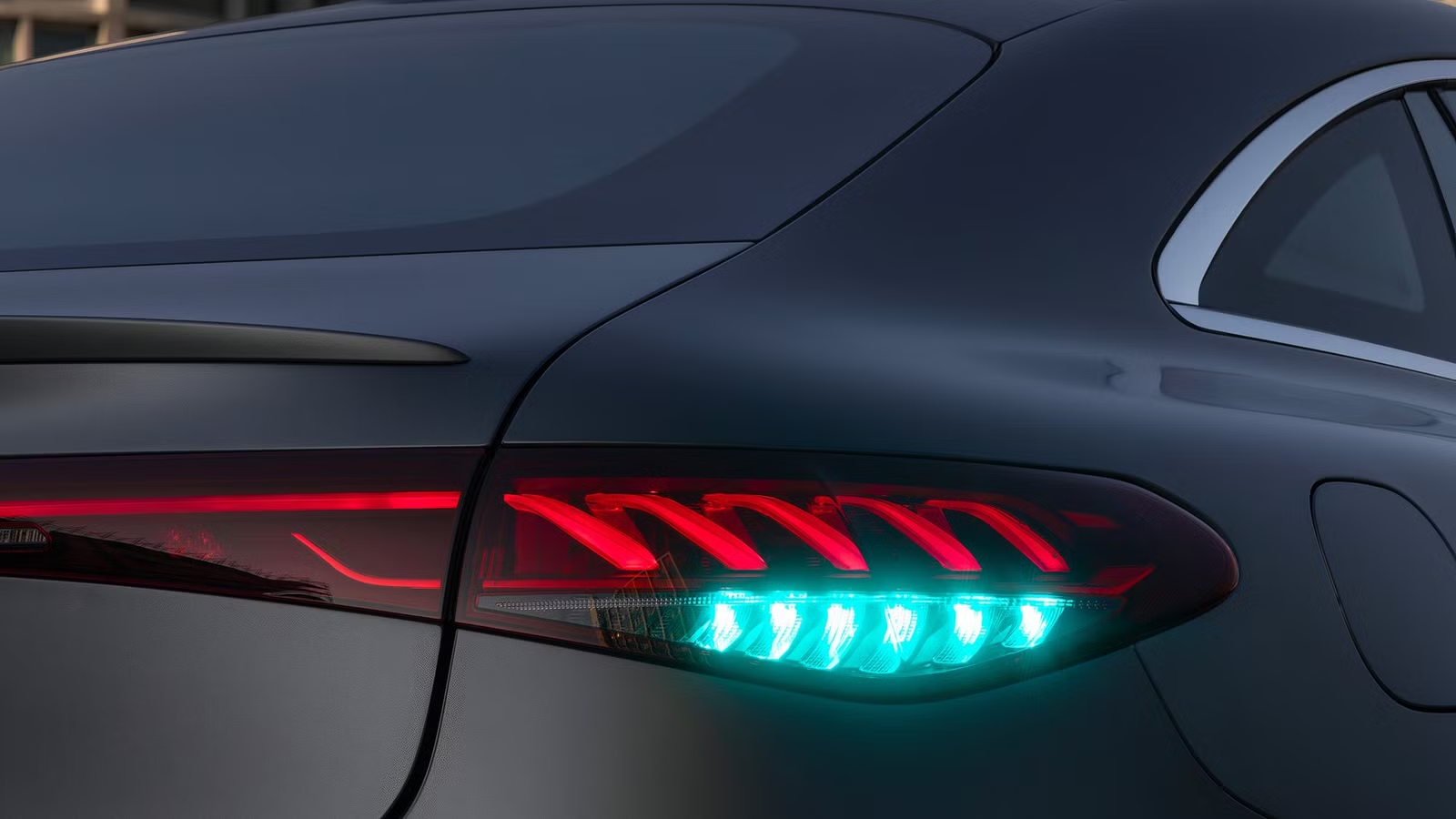
Visually and technologically, the 2027 facelift attempts to bridge the gap between the brand's traditional heritage and its digital future. The front fascia has been significantly revised, moving away from the polarizing blank panel. It now adopts a design that features illuminated chrome slats and a returned standing star hood ornament. The brand's goal is to bring the EQS's design closer to the classic S-Class aesthetic.
Inside, the cabin undergoes a digital revolution with the debut of MB.OS. This is a proprietary operating system that replaces the older MBUX software to provide a more seamless, AI-driven user experience. Most notably, Mercedes has introduced an optional steer-by-wire system paired with a yoke steering wheel. This makes it the first time a German manufacturer has brought this technology to a production luxury sedan. These updates represent a dramatic attempt by Mercedes to protect the model's flagging residual values by future-proofing its core hardware against the rapid obsolescence that plagued the pre-facelifted iteration.
The 2027 Mercedes-Benz EQS comes standard with a robust suite of luxury amenities designed to justify its $105,500 MSRP. The dash is centered around the expansive 55-inch MB.OS Hyperscreen that stretches across the dashboard. Standard comfort features include heated and ventilated power front seats with memory, a panoramic roof, 64-color active ambient lighting, and four-zone automatic climate control with pre-entry conditioning.
For entertainment, all models are equipped with a Burmester 3D Surround Sound system featuring Dolby Atmos integration and specialized EV Sound Experiences. Convenience is anchored by the Keyless-Go system with seamless retracting door handles, a power liftgate, and the newly standard 10-degree rear-axle steering, which significantly reduces the turning radius of the large sedan.
The optional specification list remains extensive and focuses heavily on the rear-cabin experience. The Pinnacle Trim and executive seating packages add multicontour rear seats with massage, rapid-heating neck and shoulder pillows, and the MBUX High-End Rear Seat Entertainment system. These add dual 11.6-inch touchscreens for passengers.
Exclusive convenience options include the Automatic Comfort Door Package, which can open and close the driver and passenger doors upon approach. There's also a sophisticated HEPA filtration system via the Energizing Air Control Plus suite. This scrubs the cabin air of 99 percent of particulate matter. Additional tech upgrades include an augmented reality head-up display and a cabin fragrance system that diffuses Mercedes’ signature scents.
Pricing for the 2027 model year reflects the brand's attempt to stabilize the EQS's market position amidst heavy depreciation. In the U.S., the lineup is structured across three primary configurations, starting with the 400 4Matic at $105,500. Following this is the $128,500 EQS 550 4Matic, and the flagship AMG EQS with 4Matic+, which will cost $149,800.
These prices reflect base MSRP before the application of optional Exclusive or Pinnacle trim packages, which typically add between $4,000 and $10,000 to the final sticker price. Given the current market volatility, many dealers are offering significant incentives to offset the loss of federal tax credits.
Found an error? Send it info@www.topspeed.com so it can be corrected.
Sources: Mercedes, the EPA, iSeeCars, J.D. Power, and CarEdge.
Source: https://www.topspeed.com/ev-financial-disaster/
Cars
The EV That Was Supposed To Succeed—But Became A Financial Disaster Instead
Article Top Ad Zone
Article Middle Ad Zone
Article Bottom Ad Zone
Original Source: www.topspeed.com
Share
Comments
Comment system is currently disabled.