Beauty may lie in the eyes of the beholder, but in automotive parlance, the more expensive a car, the more likely its styling tends to appeal to the majority. It is perhaps part of the human psyche. Makers of luxury vehicles and supercars are often credited with having some of the best designers in their teams, and usually, the brand badge itself is taken as the crowning jewel of the visual profile.
The thing is, however, that the beauty of a machine on wheels isn't always defined by the price tag attached to it. And there are car brands that have built a reputation for offering options that look stunning without asking for an arm and a leg from potential customers in return.
The design language followed by a car brand often serves the broader purpose of defining what the brand stands for and showcasing its vision for the present as well as the future. Hyundai, for instance, introduced its Sensuous Sportiness design philosophy in 2018 with an aim to blend emotional appeal with athletic styling on its vehicles. Kia showcased its Opposites United design philosophy in 2021 to highlight how contrasts like sharp lines with smooth surfaces or nature and technology can assimilate into each other on its vehicles' styling.
Ford showcased its Kinetic design philosophy in the 2000s to lend its vehicles a more athletic and dynamic appearance. In the luxury space, Volvo has always underlined its Scandinavian heritage in the design of its vehicles, while Mercedes has its Sensual Clarity design language to showcase how ditching excessive lines, edges, and decorative additions in favor of more organic contours can silently flaunt premium visual appeal. But flaunting a premium visual appeal minus a high asking price is possible, too. Just ask Mazda.
Across the world, Mazda has carefully earned a reputation for designing some of the best-looking car models in the mass-market segment. It is quite an achievement because, while looks can be very subjective, the styling on Mazda models tends to find far more admirers than critics. And this is largely due to the company's Kodo design philosophy, which is influenced by Japanese minimalism to express the essence of animal dynamism in vehicular form. "Our designers invoke this energy and cadence through strong rises and deep falls in the shape of our cars to create a sense of motion, even when standing still," the company explains. And this is at play on all Mazda models offered, including the most affordable sedan and hatchback versions.
Discover the unexpected choice that blends sporty performance with everyday practicality, redefining affordable driving.
At a starting MSRP of a little over $25,000, the 2026 Mazda 3 hatchback is one of the most affordable models from the Japanese brand in the US market. But while it may be (relatively) affordable to purchase, it is also one of the most stylish models to drive around in — a clear case that money doesn't define beauty. Did you know — the hatchback won the 2020 World Car Design of the Year award, becoming only the second from Mazda to earn the title after the MX-5 in 2016? One look at the exterior elements, another at the premium appeal in the cabin, and then at the performance credentials, and it becomes clear how the Mazda 3 plays on its power of three to punch way above its weight.
The Mazda 3 is one of the most stylish-looking hatchbacks on American roads, which are otherwise dominated by massive SUVs and stretched sedans. And while the hatchback segment as a whole may be under pressure, the Mazda 3 competes with a certain flair that none of its direct rivals can claim to possess, appearing stylish both when on the move or just standing still.
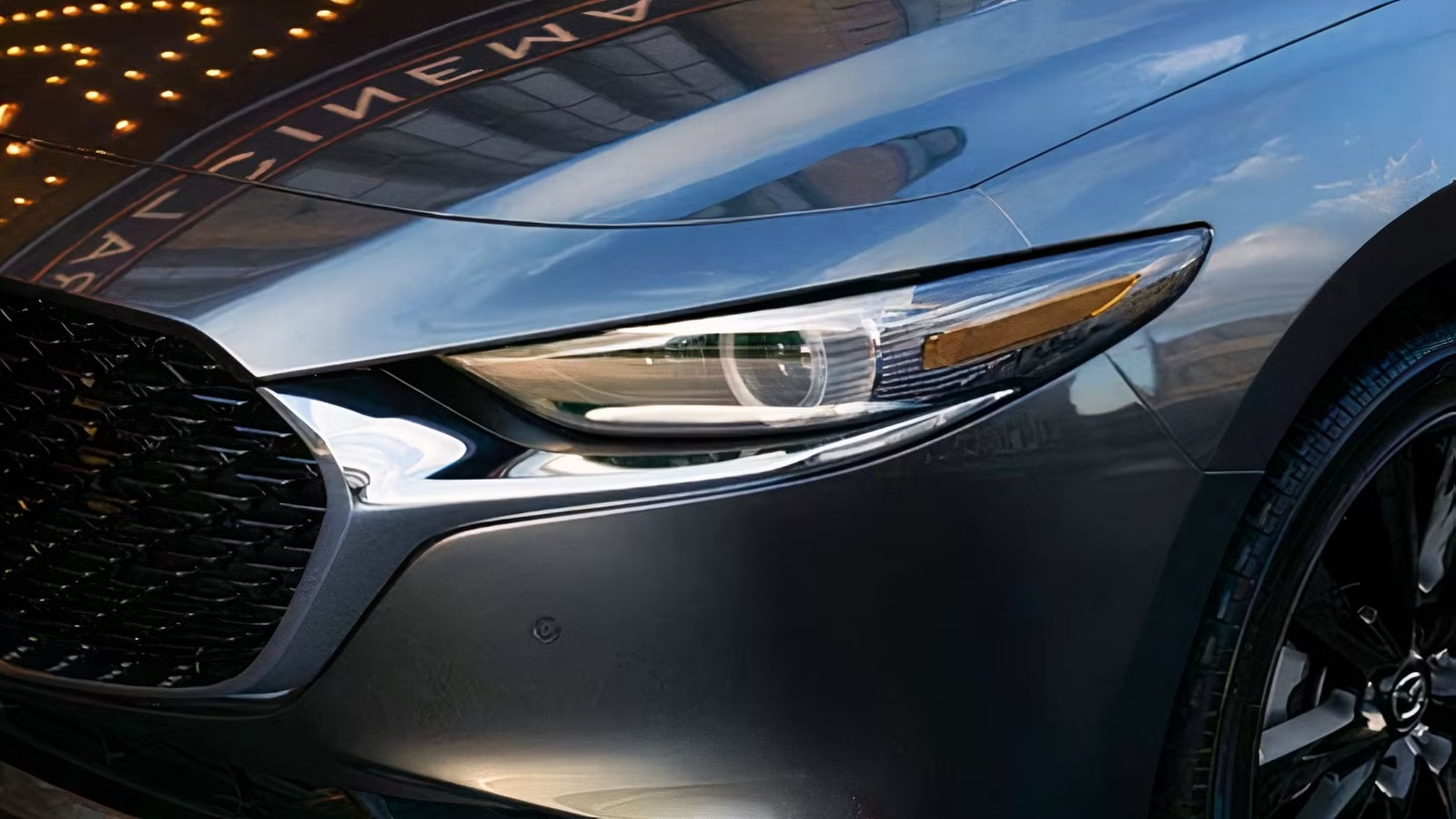
With some semblance of an Alfa-Romeo Giulietta from certain angles, the Mazda 3 hatchback otherwise benefits generously from the Kodo design language. Large, flowing panels provide an uninterrupted visual cue from the side, while the roofline tapers dramatically towards the rear to complete a swept-back design element usually reserved for far more expensive cars. The face itself is neat, with well-proportioned, well-contoured bumper and headlight units. The rear profile, too, is clean, chiseled, and yet, hardly extravagant, which only goes to prove that this hatchback isn't trying hard to impress, even if it is doing just that.
Sharp handling, thrusty power, and space for the whole family for under $25,000. What more could you want?
The Mazda 3 hatchback isn't just a great looker on the outside but in the cabin, too. Depending on the trim selected, one can have the model with red leather-trimmed/leatherette seats, plenty of soft-touch materials, and an ambiance that, while obviously not lavish, is carefully tailored to look quite upmarket.
Even the dashboard layout is clean, and while there is nothing outwardly premium anywhere around, the interplay of analog with digital elements on the instrument cluster, the well-proportioned central display unit, and the sleek center console lend it a fairly upmarket feel. This also helps Mazda rank high in interior quality assessments, with the brand securing the second spot among mainstream brands in the 2024 J.D. Power Initial Quality Study.
The design silhouette of the Mazda 3 hatchback isn't just to add cosmetic value but has functional advantages as well. With a drag coefficient of 0.28 for models between 2019 and 2024 (Mazda hasn't officially revealed this value for 2025 and 2026 model years), the car is fairly agile in piercing its way forward, offering a sporty performance.
And although the Mazda 3 sedan is even better in this regard, with a value of 0.26, the hatchback still manages to offer very low wind noise and a respectable EPA-estimated fuel efficiency of 26 mpg within city limits and 34 mpg on highways. Integrated spoilers on the higher trims (optional on lower trims) further help improve vehicle stability at high speeds while obviously adding to the sporty visual flair.
The GR Corolla is nice, but its $50,000 price tag is not.
The Mazda 3 hatchback is a practical purchase, not a compromised conclusion. It doesn't mimic far more premium models and instead, takes its own strengths closer to pricier alternatives. And yet, Mazda has managed to keep a firm grip on the pricing to make this a very compelling option. It needs to because the field of play has some very credible rivals, like the Honda Civic Hatchback, Toyota Corolla Hatchback, Subaru Impreza, and even the fan-favorite Volkswagen Golf GTI.
Hatchbacks in the US market form a niche segment, and, as such, there isn't a large pie for the taking for models competing here. This only makes every inch gained absolutely crucial. And this is especially why pricing matters to a large degree.
In a world that mostly believes big is beautiful, hatchbacks aren't exactly selling by truckloads. It may not yet be an existential crisis for the body type, but the sales trends aren't heartening either. As such, options here need to be absolutely compelling in almost every regard to strike a chord with a select group of car-buying audience. The Mazda 3 hatchback does just that.
Clever pricing doesn't come at the altar of cost-cutting, and instead, the Mazda 3 hatchback nails the visual appeal with a confident poise. As with hatchbacks, the rear seats don't offer a lot of space, and visibility through the rear glass is compromised.
On the flip side, one gets a car that's lively on the road — it even offers a six-speed manual, AWD as optional — has a pleasing cabin, looks premium, and even manages to hold value well at a depreciation rate of anywhere between 27 percent and 29 percent over a five-year period, as per Kelley Blue Book. It may still not sell as much as its Japanese cousins, the Corolla and Civic hatches, but as far as overall reputation goes, the Mazda 3 hatchback is second to none.
Found an error? Send it info@www.topspeed.com so it can be corrected.
Source: Mazda, J.D. Power, KBB, The EPA
Source: https://www.topspeed.com/car-looks-better-at-this-price/
Cars
The Car That Looks Better Than It Has Any Right To At This Price
Article Top Ad Zone
Article Middle Ad Zone
Article Bottom Ad Zone
Original Source: www.topspeed.com
Share
Comments
Comment system is currently disabled.