Israel imported military-related goods from six European countries despite arms restrictions.
On a cold day in early January 2024, protesters gathered outside the International Court of Justice (ICJ) in The Hague to denounce Israel’s genocidal war on Gaza, then nearly 100 days old.
More than 3,000km (1,864 miles) away, some Palestinians in Gaza followed the proceedings, livestreamed on YouTube, but most were trying to survive Israel’s relentless bombardment.
In nearly eight decades of the Convention on the Prevention and Punishment of the Crime of Genocide, only a handful of cases had ever reached the court. That day, South Africa was asking the world’s highest court to consider whether Israel’s assault on Gaza constituted a genocide - the destruction, in whole or in part, of an ethnic, racial, religious or national group.
Inside the courtroom, Irish lawyer Blinne Ni Ghralaigh, who was representing South Africa, began to speak.
“The international community continues to fail the Palestinian people,” she told the judges, despite Israeli officials’ “dehumanising, genocidal rhetoric” matched by the military actions in Gaza.
“This is the first genocide in history, where its victims are broadcasting their own destruction in real time, in the desperate, so far vain, hope that the world might do something,” she said.
An average of 247 Palestinians were being killed every day, Ni Ghralaigh told the court; 48 mothers, two every hour; more than 117 children daily, five each hour.
She referred to the new acronym used among doctors and aid workers that had emerged from the devastation: WCNSF - wounded child, no surviving family. By that point, more than 7,000 Palestinians had been killed.
“These facts,” Ni Ghralaigh said, “could not present a clearer or more compelling case” for genocide.
On January 26, 2024, the ICJ ruled that there was a plausible risk of genocide in Gaza and ordered provisional measures. Crucially, it reminded all states party to the Genocide Convention, of which there are 153, of their obligations: to act to prevent genocide.
But over the next 22 months, the killing continued. By the time a ceasefire was reached in October 2025, more than 70,000 people had been killed, with some 171,000 injured.
Throughout that period, the weapons to Israel kept flowing.
A months-long Al Jazeera investigation has found that military-related goods originating from at least 51 countries and self-governing territories continued entering Israel after the ICJ’s warning of a plausible risk of genocide in Gaza.
Based primarily on an analysis of Israeli Tax Authority (ITA) import data between 2022 and 2025, and supported by customs records and freedom of information requests, the investigation traced military supply chains linked to countries across Europe, Asia, North America and South America. All named countries are signatories to the Genocide Convention.
In some cases, the military-related goods originated from countries that had formally imposed arms embargoes on Israel or had partially suspended arms supplies to the country.
In fact, according to the ITA data, arms imports increased after the ICJ ruling, with the largest share falling under the category of munitions.
The five largest countries of origin for military-related goods entering Israel - the United States, India, Romania, Taiwan and the Czech Republic - all recorded increased shipments during the war.
While many countries included in this investigation do not share statistics on arms exports to Israel, the ITA data shows that 2,603 consignments of military-related goods - including imports labelled as goods related to ammunition, explosive munitions, weapons parts and armoured vehicle components - entered Israel between October 2023 and October 2025.
In total, the imports were valued at 3.22 billion shekels ($885.6m), with 91 percent of that value recorded after the ICJ’s ruling, according to the ITA data.
By comparison, in the 20 months before October 2023, military-related imports to Israel totalled 1.41 billion shekels ($388.1m). The data suggests Israel increased its dependence on foreign weapons supplies to help sustain its military offensive in Gaza.
Even after the latest ceasefire took effect on October 10, 2025, the flow of weapons did not stop. In the final two months of 2025, Israel received an additional 324.9 million shekels ($89.4m) in military-related imports, according to the ITA data.
Legal scholars say the governments that continued to arm Israel after the ICJ ruling could be complicit in genocide.
Stephen Humphreys, professor of international law at the London School of Economics, told Al Jazeera that even before the ruling, there was “ample evidence that countries arming Israel may be complicit in international crimes, including war crimes and crimes against humanity”.
Gerhard Kemp, a professor of criminal law at the University of the West of England, said Gaza remains the subject of an ongoing genocidal campaign.
“The most recent ‘ceasefire’ did not change this,” he said, pointing to continued military operations, the killing of civilians and the imposition of conditions of life that could destroy the group in whole or in part.
Under the Genocide Convention, states have a duty not only to punish genocide but also to prevent it. Kemp said the obligation is triggered not by a final court ruling but by knowledge of a serious risk.
“Some states have a very narrow understanding of the duty to prevent genocide and are waiting for a judicial determination that there is a genocide in Gaza,” Kemp said. “But the ICJ will likely take several years to make such a determination. The better view is to look at domestic legal obligations ... and international legal obligations and legal tools triggered by available evidence.”
He pointed to the findings of the United Nations Independent International Commission of Inquiry on the Occupied Palestinian Territory, which published a report in September 2025, concluding that Israel “committed a genocide against the Palestinians in Gaza”.
Kemp cited the commission’s conclusion that “states are obliged to take steps to ensure the prevention of conduct that may amount to an act of genocide ... including the transfer of weapons that are used or likely to be used by Israel to commit genocidal acts”.
The report, he acknowledged, was not binding on UN member states. “But it is authoritative regarding existing legal obligations. I think it would be prudent for states to give effect to the commission’s findings and recommendations, especially regarding weapons delivery to Israel,” he said.
Beyond the Genocide Convention, lawyers note, Article 6 of the Arms Trade Treaty prohibits authorising transfers where there is a clear risk the weapons could be used to commit serious violations.
Meanwhile, countries must also contend with their own domestic legal obligations. This includes “laws in the UK and other states that require due diligence in the export of weapons to states potentially or plausibly involved in the commission of international crimes”, Kemp said.
The ITA maintains a publicly accessible database of imports organised by eight-digit customs codes.
These codes are structured according to the World Customs Organization’s Harmonized System (HS). The first six digits correspond to internationally standardised product categories, while countries are permitted to provide more detailed national statistics by adding digits. In the case of Israel, it often uses eight-digit codes – the global six digits plus two additional digits for national detail.
Al Jazeera analysed more than 6.5 million individual customs entries covering Israeli imports between 2022 and 2025. The investigation focused on imports where customs codes begin with “93”, the HS chapter covering arms and bullet-related exports, as well as code 87100000, which covers tanks and other armoured fighting vehicles and their parts.
According to Israel’s customs codebook, these codes include:
Explosive munitions, such as “bombs, grenades, torpedoes, mines, missiles and similar munitions of war and parts”. It also labels “cartridges”, some types of “ammunition and projectiles” and parts, including “shot and cartridge wads” (93069090)
“Parts and accessories” of military weapons, including components for “revolvers and pistols” (93051000)
Parts and accessories of military weapons (93059100)
“Other” types of parts and accessories (93059900)
“Rocket launchers, flamethrowers, grenade launchers, torpedo tubes and similar projectors” (93012000)
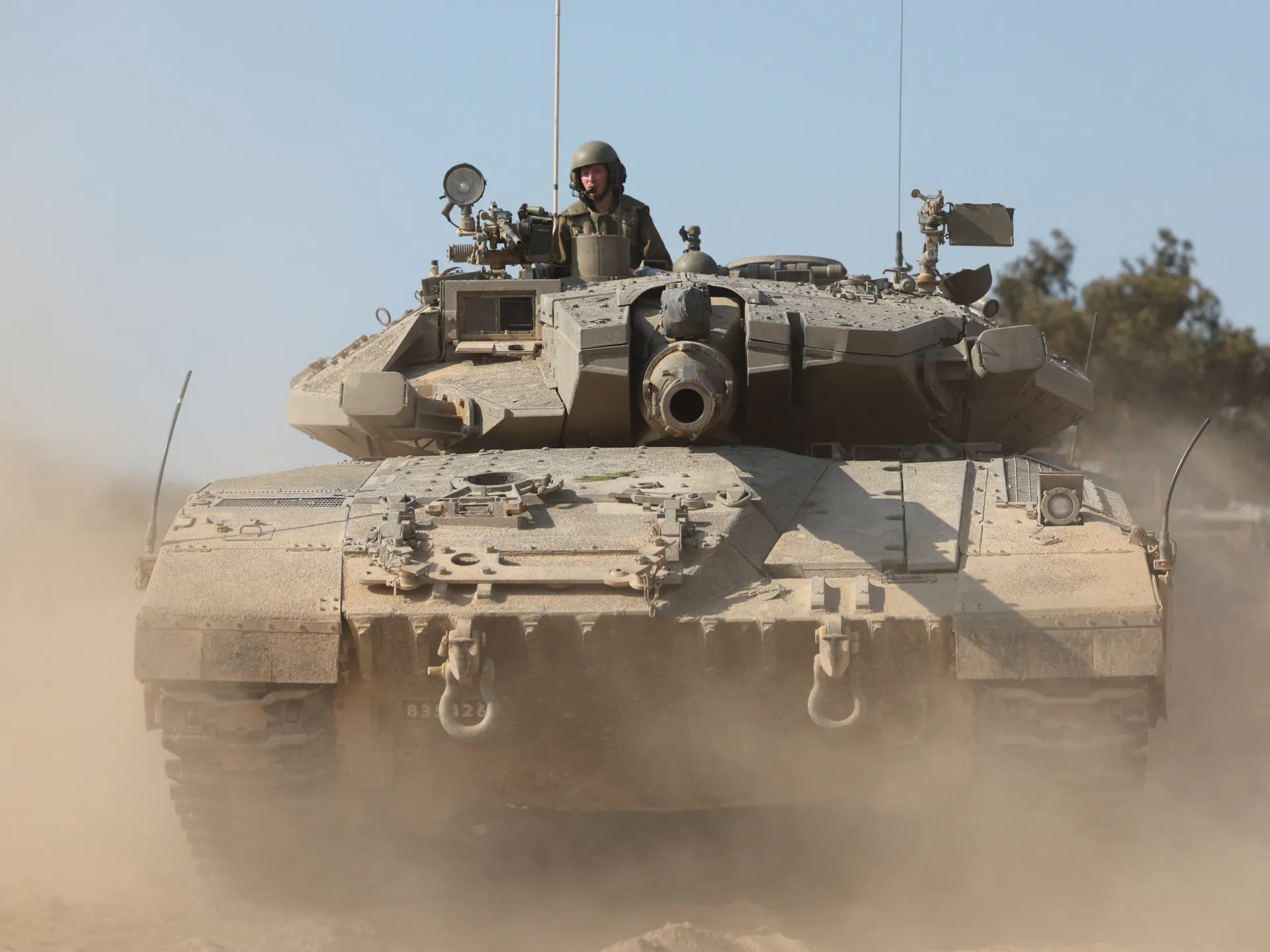
“Tank and other armoured fighting vehicle, motorised, whether or not fitted with weapons, and parts” (87100000)
While this dataset provides an unusually detailed picture of Israel’s weapons-related imports during the war, it represents only a partial view of total arms transfers.
The customs records do not specify the exact nature of the item, the final recipient or the end user of the items shipped.
The data records an “origin country” for imported goods, but this does not necessarily mean the items were exported directly from that country into Israel. They may instead have been routed through third countries.
In many international arms supply chains, military-related components are incorporated into wider weapons systems or transferred between manufacturers before ultimately reaching their final destination.
Arms experts told Al Jazeera that many governments assess the intended end user of military-related goods before approving exports, but do not systematically conduct post-shipment verification overseas to determine how components are ultimately used once transferred through international supply chains.
However, all goods recorded under these codes are classified as military-related under the Israeli import system.
In some instances, weapons experts say, the military equipment may be used for training purposes.
The data also records the point of entry for each shipment, including Ben Gurion airport, ports of Haifa and Ashdod, and the Jordan River crossing.
Al Jazeera’s analysis does not include weapons supplied to Israel free of charge, military aircraft or jet parts, and strategic communications or radar systems.
Weapons experts consulted by Al Jazeera said these categories are often recorded under broad customs headings that can, in some cases, include civilian goods among military exports – for example, with aircraft parts used in commercial aviation – making it impossible to determine with confidence whether such shipments were military in nature.
For that reason, Al Jazeera excluded customs codes where the military-related nature of the goods could not be established with sufficient certainty.
Because the Israeli import dataset does not specify precise models or end users, Al Jazeera sought independent documentation to test whether shipments recorded under HS codes beginning with “93” correspond to identifiable weapons components moving between named defence companies.
Al Jazeera obtained 91 Indian customs export documents covering arms-related shipments to Israel in 2024 under the classification code 93069000.
HS code 9306 refers to “bombs, grenades, torpedoes, mines, missiles and similar munitions of war, and parts thereof”. The Indian subcategory 93069000 is labelled “bombs, grenades”, according to India’s Ministry of Commerce and Industry’s customs book.
The documents show Indian firms exporting weapons components to Israeli arms manufacturers, including Rafael Advanced Defense Systems, IMI Systems Limited and MCT Materials.
Across multiple consignments, Kalyani Rafael Advanced Systems Private Limited (KRAS) – a joint venture between India’s Kalyani Strategic Systems and Israel's Rafael Advanced Defense Systems – exported a combined total of 554,120 units described as “HEAVY FRAG” components to Rafael Advanced Defense Systems. Arms specialists who reviewed the records said fragmentation components are typically used in explosive munitions that disperse metal fragments upon detonation.
Kalyani Strategic Systems, the Indian partner that holds a majority stake in KRAS, exported 50 units labelled “155MM PROJECTILE BODY” to IMI Systems. Weapons experts said a 155mm projectile body is the main steel casing of a large artillery shell, designed to be filled with explosives.
Economic Explosives Limited (India) exported 99,400 units described as “booster pellet (munitions, defence)” to Reshef Technologies Limited in Israel. Experts said booster pellets are used to initiate larger explosive charges in military munitions.
Other shipments included 320 units described as “munition metal parts”, exported by Ashoka Manufacturing Private Limited to MCT Materials.
These documents do not cover the full range of Indian exports and they do not establish end use in Gaza. But they provide a granular view of the kind of imports Israel received under HS code “9306”.
Al Jazeera contacted the Indian government for comment, but had received no response by the time of publication.
The US was Israel’s largest supplier of military-related imports during the war, accounting for more than 42 percent of the total declared value identified in this investigation, according to the ITA data.
India ranked second, responsible for about 26 percent.
These two countries accounted for more than two-thirds of the total value of arms imports recorded.
The next three biggest suppliers were Romania (8 percent), Taiwan (4 percent) and the Czech Republic (3 percent).
Member states of the European Union collectively accounted for nearly 19 percent of the total value of Israel’s weapons-related imports.
A further nearly 8 percent came from East and Southeast Asia, including Taiwan, China, South Korea, Vietnam and Singapore.
The data also shows shifts in supply patterns over time.
From January 2022 to September 2023, two of the three largest consignments to Israel worth a combined 80.9 million shekels ($22.3m) under the HS code for explosive munitions came from Azerbaijan. This fell to a total of 8.2 million shekels ($2.3m) during the genocidal war on Gaza.
Arms and munitions worth 40.4 million shekels ($11.1m), originating from the Netherlands under the same HS code, were sent to Israel in August 2022; by contrast, Dutch military exports to Israel during the entire war were worth 105,000 shekels ($29,000).
A spokesperson for the Dutch Ministry of Foreign Affairs told Al Jazeera that “the export of military goods to Israel is only approved for purely defensive purposes”.
But Al Jazeera’s analysis indicates that several other countries substantially increased the scale of their military-related goods imported into Israel during the war compared with the preceding 21 months, the earliest period available due to the ITA data only dating back to 2022.
That includes the top five suppliers of military-related consignments: the US, India, Romania, Taiwan, and the Czech Republic.
It also includes smaller quantities of military supplies from nations that publicly backed the ICJ’s January 2024 ruling.
China, for instance, said it hoped the provisional measures ordered by the court would be implemented effectively. However, military-related shipments to Israel originating from China totalled 71.1 million shekels ($19.6m) during the war, with roughly 83 percent of that value logged after the court ruling.
Al Jazeera contacted the Chinese government for comment, but had received no response by the time of publication.
Singapore noted that ICJ orders are generally “binding”, and said it had supported UN resolutions calling for an “immediate humanitarian truce or ceasefire”. But Israeli customs data shows 20.2 million shekels ($5.6m) in military-related imports from Singapore during the war, 88 percent of which were recorded after the ICJ decision.
Switzerland reiterated its support for the ICJ’s role in the peaceful settlement of disputes, and "full respect for international law”. But 9 million shekels ($2.5m) worth of Israel’s military imports during the war originated in the Central European nation, with 98 percent of the total registered following the ruling. The Swiss government, in a statement, confirmed to Al Jazeera that licences for “specific military goods have been granted”.
Even countries that were among the strongest pro-Palestinian voices on the world stage had military-related goods originating from their territories enter Israel during the war - even if the quantities were much smaller - according to the ITA data.
Turkiye’s President Recep Tayyip Erdogan said he hoped Israel’s attacks on women, children and elderly people would end. Military-related goods originating from the country totalled 7.5 million shekels ($2.1m), with 79 percent recorded after the ICJ order.
The Turkish government told Al Jazeera in a statement that, from May 2, 2024, “exports, imports, free zone trade, and transit trade from Türkiye to Israel across all product groups have been completely halted” and that “trade with Israel has been at zero” since that date.
It also said “no arms export permits were granted to Israel by Turkish authorities” after October 7, 2023.
Israeli customs data reviewed by Al Jazeera does show that entries through Israel’s Ashdod port stopped after May 2024, following Turkiye’s announcement that trade had been suspended. However, military-related goods recorded as originating from Turkiye continued to enter Israel via Ben Gurion airport and Haifa port after that date, according to the ITA data.
Brazil, likewise, stressed that the ICJ’s measures were legally binding and called for full and immediate compliance. But military-related shipments originating from the country totalled 8.7 million shekels ($2.4m) during the war, almost 80 percent of that after January 2024.
Brazil’s Ministry of Foreign Affairs told Al Jazeera the country had not approved any new defence-related export requests to Israel since February 9, 2023. However, it said certain categories - including some firearm components, accessories, small-calibre ammunition, defence-related manufacturing inputs and military training equipment - are not subject to prior approval by the Foreign Ministry.
Patrick Wilken, a researcher at Amnesty International, said the scale of Israel’s military campaign made such international support indispensable.
“There is no way that Israel alone could have sustained the intensity of its massive bombardment across the Gaza Strip,” he said. “Israel has relied on a global supply chain of arms, munitions and support services, primarily supplied by the United States but supported by many other states.”
As the war continued, weapons-related imports to Israel increased. The data appears to bear that out.
The first four months - between October 2023 and February 2024 - saw the lowest number of imports throughout the genocidal two-year war.
As the war dragged on, with tens of thousands of civilians killed, schools and universities bombed, and hospitals struck, that changed.
In March 2024, the military imports of 121.7 million shekels ($33.5m) were more than double the amount from December 2023. South Korea’s largest consignment of the period entered Israel this month, with 14.0 million shekels ($3.8m) in tank and armoured vehicle parts, according to the ITA data.
In May 2024, as Israeli forces pushed into the southern Gaza city of Rafah, the ICJ ordered Israel to halt its offensive there, citing an “immense risk” to the Palestinian population.
But Israel’s armoury was still filling up. Consignments surged again, a new record high since October 2023, reaching about 141.7 million shekels ($39m). Bulgaria’s largest shipment of the war arrived that month, 20.1 million shekels ($5.5m) in explosive munitions, while the Czech Republic recorded its biggest month overall for military-related exports to Israel, worth 10.5 million shekels ($2.9m).
As the war continued, hundreds of thousands of people across the world’s biggest cities took to the streets demanding an end to the fighting and calling on their governments to halt arms exports to Israel.
Many states announced arms embargoes - government-imposed restrictions on the sale or transfer of weapons and military equipment to a specific country. Others opted for more limited suspensions of arms sales, typically temporary or partial halts applied to certain licences or categories of equipment.
Anna Stavrianakis, a professor of international relations at the University of Sussex and expert on the global arms trade, said public pressure played a decisive role in pushing governments to reassess their export policies.
“In several cases, it has been public protest, labour organising and strategic litigation that has forced arms-exporting states to reconsider or restrict transfers,” she told Al Jazeera.
In the United Kingdom, a case brought by Al-Haq, an NGO based in the occupied West Bank, and nonprofit Global Legal Action Network (GLAN), and supported by Amnesty International and others, challenged Britain's arms exports in court.
In Spain, dockworkers refused to handle ships reportedly carrying military equipment bound for Israel, prompting authorities to block or investigate shipments.
In Canada, demonstrations and pressure from lawmakers preceded a parliamentary vote calling for a halt to transfers, after which the government paused new permits. In France, large-scale protests intensified scrutiny of arms sales.
Stavrianakis added that these debates within countries exposed tensions between governments’ strategic commitments to Israel and domestic demands to ensure compliance with international legal obligations.
Martin Drew, an expert in export controls, argued that restrictions on arms exports were not a substitute for legal measures to prohibit weapons sales.
“A government can create restrictions on export licences,” he said. “But that is policy rather than law. It means they can still authorise exports if they choose to.”
In practice, most defence contracts include a clause stating that delivery is “subject to export licence approval”. If a licence is revoked, shipments may be paused or cancelled, he said. But if a government only stops issuing new licences, existing licences may remain valid, allowing previously approved exports to continue.
Drew said the type of licence also matters.
In the UK, for example, a Standard Individual Export Licence (SIEL) covers a specific shipment of a specific item. If that licence is suspended, the export stops. However, this may also be appealed.
But other licences, such as the UK’s Open Individual Export Licences (OIELs) or Open General Export Licences (OGELs), can cover multiple shipments over a set period. These broader licences can remain in force even after political announcements about “suspensions”, depending on how the policy is implemented.
There are also wider industrial consequences. Defence companies and partner governments rely on supply chains that operate over several years, often linked to multiyear procurement contracts and long production timelines. If a country suspends export licences unpredictably, it may face reputational and commercial risks.
“Major defence contracts depend on trust,” Drew said. “If buyers think you may not fulfil your commitments, they may turn elsewhere.”
He added that large weapons systems, including jet programmes, typically run over years, and sometimes decades, relying on export orders to spread costs and sustain manufacturing. Disrupting licences via suspensions or embargoes can therefore affect not just a single shipment, but the viability of entire production lines.
The result is that governments often try to balance political pressure, legal risk and industrial interests, which can produce policies that appear restrictive in public statements but are narrower in practice.
Under Prime Minister Pedro Sanchez, Spain became one of Israel’s most vocal critics in the EU, calling for a ceasefire and backing international legal action.
In January 2024, Spain’s foreign minister said the country had not sold any weapons to Israel since the start of the war, insisting an embargo was already in effect. But a legally binding embargo was not written into law until October 2025, the month the latest "ceasefire" was announced.
Israeli customs data reviewed by Al Jazeera recorded 99 shipments of military-related goods originating from Spain worth 21.6 million shekels ($5.9m) by then. Its largest consignment, 4 million shekels ($1.1m) labelled under the HS code for explosive-type munitions, entered Israel in December 2023.
Al Jazeera contacted the Spanish government for comment, but had received no response at the time of publication.
Ottawa followed Spain’s example, saying in January 2024 that it would stop approving new arms exports to Israel. The policy was formalised in March 2024, following a parliamentary vote referencing the ICJ’s provisional measures.
However, the final wording of that motion fell short of demanding a complete halt to all military trade. Instead, it asked the government to stop approving new authorisations and transfers.
Critics say this “watered-down” language has allowed military-related imports to continue entering Israel.
Between October 2023 and October 2025, Canada recorded 23 shipments of military-related goods to Israel worth approximately 1.7 million shekels ($458,000). Nineteen of these shipments were logged in the ITA data as occurring after the parliamentary vote calling for an end to arms exports to Israel.
The Canadian government told Al Jazeera that it does not comment on the specifics of individual export permit applications or transactions due to “commercial confidentiality”.
The Global Affairs Canada said it had not approved any new permits for items that could be used in the genocidal Gaza war since January 8, 2024, but acknowledged that “not all exports from Canada require an export permit”.
It also said all permits suspended in 2024 remain so and cannot be used to export to Israel.
Canadian officials did not say whether military-related shipments recorded in Israeli customs data were imported into Israel under permits approved before January 2024.
Experts say France chose political signalling over a binding ban. On October 5, 2024, President Emmanuel Macron called for a halt to arms deliveries to Israel, saying the priority was to return to a political solution and stop supplying weapons used in Gaza. The statement marked one of France’s strongest public interventions of the war.
But it did not amount to a legal embargo.
The month before Macron’s announcement, 19 million shekels ($5.2m) of military-related goods originating from France entered Israel, one of 29 consignments to Israel between October 2023 and September 2024.
France's exports to Israel did not stop even afterwards.
The ITA data shows 25 shipments entered Israel after France announced a halt in deliveries. In total, 49.9 million shekels ($13.7m) in military-related goods arrived in Israel, with 92 percent of that value recorded after the ICJ ruling.
Al Jazeera contacted the French government for comment but received no response at the time of publication.
Days after Macron’s announcement, Rome also said it had suspended shipments of military equipment linked to the genocidal war on Gaza, framing the move as temporary rather than permanent.
However, after the arms suspension was announced, 33 additional consignments were recorded, continuing until the month before the "ceasefire", according to the ITA data. These post-announcement imports by Israel were worth 5.1 million shekels ($1.4m). During the war, Italy’s total of military-related goods to Israel was worth 24 million shekels ($6.6m) across 98 consignments.
The Italian government told Al Jazeera it had adopted a “particularly restrictive” approach to exports to Israel, “especially when compared with the stance adopted by other partner countries, including within the European Union”.
Italian officials also said Italy was “among the few countries worldwide” to “operate a dual-layer preventive control system: not only on export licences, but - even prior to that - on the conclusion of contracts”.
The government said, following reviews of licences approved before the war, “one licence concerning the export of naval ammunition materials for demonstration and testing purposes only was first suspended and subsequently revoked as a precautionary measure”.
However, it added that “the remaining previously authorised licences were not suspended, as the materials concerned do not present characteristics enabling their use against the civilian population in Gaza, the West Bank or Lebanon”.
Arguably Israel’s strongest ally in Europe, Germany tightened its arms policy only near the end.
Between October 2023 and October 2025, it exported 100 consignments to Israel worth approximately 43.5 million shekels ($12m).
In August 2025, Chancellor Friedrich Merz said Germany would no longer authorise exports that could be used in Gaza “until further notice”.
By then, most exports had already taken place, and Gaza was in ruins. A month after Merz’s statement, the third-largest recorded single consignment, worth 2.9 million shekels ($794,000), arrived at Ben Gurion airport.
The German government told Al Jazeera in a statement: “The Federal Government decides on the granting of licences for arms exports on a case-by-case basis and in the light of the specific circumstances, following a thorough assessment that takes into account foreign and security policy considerations in accordance with legal and political guidelines. This also applies to Israel.
“In doing so, the Federal Government takes into account compliance with international humanitarian law. Particular consideration is also given to the recipient country, the type of military equipment and its intended use.”
In early 2024, the UK - traditionally one of Israel’s strongest allies - started shifting its position, after it formally voted for a UN Security Council resolution calling for a temporary ceasefire.
A few months later, Keir Starmer was elected prime minister on a platform that called for an “urgent” and “immediate ceasefire”, while MPs from within the new governing party called for an arms embargo.
However, in September 2024, the government announced only a partial suspension of arms supply. It suspended 29 arms export licences after concluding the equipment might be used in serious violations of international humanitarian law, with some 350 licences remaining active.
The UK government has previously said it did not implement a full arms embargo due to the sale of F-35 jet parts, which would disrupt international supply chains. This was upheld by the High Court.
However, Al Jazeera’s analysis shows shipments recorded under military-related customs codes that are unrelated to aircraft parts also continued to enter Israel.
Between October 2023 and October 2025, 28 consignments worth 6.7 million shekels ($1.8m) entered Israel. The most valuable came well after repeated UK calls for a ceasefire. In June 2025, a consignment worth 1.9 million shekels ($535,000) entered Israel - the largest single shipment recorded in the ITA data analysed since 2022.
The UK government told Al Jazeera: “As announced to Parliament in September 2024, we suspended licences for all items that we assess could be used in military operations in Gaza, with the exception of the special measures with regard to the global F-35 programme.
“Exports of such equipment remain suspended, and since then over 50 licence applications have been refused or rejected on the same basis. Customs data does not accurately reflect export licence data and is therefore unreliable in this case.”
Al Jazeera’s investigation does not attempt to match individual customs shipments to specific UK export licences.
Data obtained by Al Jazeera through Freedom of Information (FOI) requests also reveals additional routes through which UK-origin combat aircraft parts could have reached Israel via third countries.
The documents show that the UK approved exports under what are known as “third-party” or incorporation licences. These licences allow British defence companies to ship components to manufacturers in other countries, where they are integrated into completed weapons systems that are then exported to Israel.
Between October 1 and December 31, 2024, the UK authorised licences worth 69,000 pounds ($92,000) for components for military training equipment routed via the US, 5,000 pounds ($7,000) in periscope components and related technology routed through Germany and two consignments for combat aircraft components worth 196,000 pounds ($263,000) shipped via Italy for onward transfer to Israel. These licences, for shipping via Germany and Italy, were labelled nonextant as of June 6, 2025.
A separate FOI response shows that the UK continued approving incorporation licences involving the US in 2025, with Israel listed as a potential end destination.
Between January 1 and September 30, 2025, the government authorised multiple licences covering components for combat aircraft, aero engines, targeting systems and navigation equipment, with a combined value running into the hundreds of millions of pounds. Several of the largest licences - including approvals worth 269.2 million pounds ($360m), 63.8 million pounds ($85m) and 39 million pounds ($52m) for combat aircraft components - listed Israel among a wide range of possible ultimate end users alongside the US and European allies.
Separately, two licences worth a combined 530,000 pounds ($710,000) explicitly named Israel as the sole ultimate end user, covering components for targeting equipment and military guidance and navigation systems.
The UK government also confirmed to Al Jazeera that it “does not carry out end-use verification checks overseas once the licence is issued”, relying instead on pre-export risk assessments.
The exports for incorporation licences to Israel via third countries do not appear in the UK government’s publicly reported figures for arms sales to Israel.
Campaigners say incorporation licences can obscure the ultimate destination of UK-made components and have criticised what they describe as a lack of transparency in how such exports are recorded.
Between January 19 and March 18, 2025, a temporary ceasefire and exchange of Israeli captives and Palestinian prisoners took effect. It was the second pause in the war.
According to the data analysed by Al Jazeera, some of the largest single weapons consignments recorded during the war arrived during this period, suggesting that the pause in fighting may also have created space for resupply and replenishment.
In February 2025, customs records show a shipment valued at 605 million shekels ($16.6m) entered Israel through the port of Haifa. Classified under codes for tank and armoured vehicle parts, it was the single largest weapons-related import identified in this investigation.
The data suggests the shipment arrived while the first 2025 ceasefire was still in effect. In total, 233 million shekels ($64.1m) of tank or armoured vehicle parts arrived in Israel during the genocidal war, accounting for 7.24 percent of all exports, according to the ITA data.
Sam Perlo-Freeman, a military and arms trade specialist, said the data indicated Israel may have been seeking to replenish supplies during the ceasefire. “A surge like this may indicate they needed emergency or diversified supplies,” he said.
Patrick Wilken, a researcher at Amnesty International, said large deliveries during pauses in fighting can reflect the need to replace weapons that have already been used.
“Given the sustained nature of the operations, there may have been supply pressures at different points,” he said.
Analysts say such replenishment cycles reflect logistical realities on the ground: it is harder to move large quantities of weapons during active bombardment, so lulls allow forces to resupply more efficiently.
By July 2025, hunger had become another weapon in Israel’s genocidal war on Gaza.
The Integrated Food Security Phase Classification (IPC) had warned that the enclave was at imminent risk of famine after aid was blocked months earlier. What little remained in markets disappeared.
Across Gaza, hunger was no longer an abstract warning issued by agencies. It was visible in gaunt faces, in trembling limbs, in the stillness of small bodies carried into morgues.
When a new aid system backed by Israel and the US replaced hundreds of local UN distribution points with a handful of heavily guarded “mega-sites” in Gaza, people began calling what they were witnessing “The Hunger Games”.
Sixteen-year-old Khaled Abu Jamea had gone days without food.
On July 19, Khaled and his friend Nader set out to gather food, driven by hope and hunger. “I knew there was danger, but I had no other choice. I had to go to get something to eat for myself and my family of 10.”
Each day, he said, soldiers would position themselves on raised sand berms, with tanks nearby, and drones overhead. “As soon as the truck arrives, hungry people rush forward as if in a race,” he said. “Every time, when people rushed, the occupation forces opened heavy fire.”
This day was no different. As the truck unloaded near Israeli forces, the shooting began. People scattered. Khaled was hit in the foot. Nader fell beside him, bleeding heavily.
“There was not even a wall to shelter behind,” Khaled said. “An Israeli tank fired a shell nearby. Shrapnel struck Nader. He couldn’t move.”
They were loaded onto a donkey cart and taken to Nasser Hospital. But it was too late. Nader had been hit by three bullets. His body was carried into the morgue.
According to the Palestinian Ministry of Health, Nader was among 2,600 Palestinians killed while trying to access food between May 27 and October 9, 2025. Thousands more were wounded.
“It felt as if the goal was to harm us,” Khaled said, adding that he believes he was shot using an Israeli M16 rifle.
Between October 2023 and October 2025, Israel imported goods recorded under bullet-related customs codes with a total declared value of 271.2 million shekels ($74.7m), accounting for 8.43 percent of all exports.
Arms experts said some of these imports might have been training rounds, nonlethal projectiles, or ammunition components rather than live rounds. However, all goods recorded under the military-related codes are categorised as “bullets”, according to Israel’s customs codebook.
In April 2025, the month before the first deadly incidents at Gaza Humanitarian Foundation (GHF) sites, Israel received about 38.6 million shekels ($10.6m) worth of bullet-category imports, the highest monthly total recorded up to that point since October 2023.
In July 2025, as killings at aid distribution sites intensified, Israel received a new record volume of bullet-category imports, valued at more than 45 million shekels ($12.4m), mostly from a single shipment from the US.
In the final months of the genocidal war on Gaza, as the relentless bombardment continued, Israel’s Defence Minister Israel Katz posted three words on X: “Gaza is burning.”
Days earlier, he had declared that “the bolt has now been removed from the gates of hell in Gaza”, a reference to Israel’s destruction of the Mushtaha Tower – one of Gaza’s last remaining high-rises.
Meanwhile, as the GHF’s aid sites were suspended amid mounting civilian deaths, Israel permitted a small number of foreign journalists to fly over Gaza City on aid-drop missions. They were not allowed to film.
What they described was a vision of total ruin. Below them lay a wasteland, valleys of debris and ash, neighbourhoods flattened into indistinguishable grey.
Satellite imagery confirms the scale of the destruction. According to the UN Satellite Centre, by October 11, 2025, 81 percent of all structures in Gaza had been damaged or destroyed.
The Danish Refugee Council, citing findings by the UN Commission of Inquiry, said the scale and severity of violations had “all but rendered Gaza uninhabitable”.
For genocide scholars, the destruction of a people is not measured only in bodies, but in the annihilation of the conditions that make life possible.
Experts say this level of destruction reflects the extensive use of explosive munitions, with the Gaza Government Media Office estimating that more than 200,000 tonnes of explosives were dropped on the enclave by October 5, 2025.
This category of weapons – including bombs, grenades, missiles, mines and similar weapons – formed the largest class of arms imported into Israel during the war, Al Jazeera’s investigation shows.
According to the ITA data, between late 2023 and late 2025, Israel imported 2 billion shekels ($550.3m) worth of munitions, accounting for 62 percent of all weapons imports recorded in the dataset, far exceeding any other category.
Patrick Wilken of Amnesty International said the use of weapons designed for large-scale impact in densely populated areas led to “the sustained, massive and comprehensive destruction of civilian objects and infrastructure”.
In April and July 2025, two of the largest consignments of explosive-related munitions originating from India were recorded during the war at a time when humanitarian agencies accused Israel of killing civilians seeking food aid.
High-volume military-related imports continued into the final months of the war. In August 2025, Israeli customs data recorded a shipment of explosive munitions originating from Romania worth 20.8 million shekels ($5.7m) – the country’s largest recorded consignment during the conflict. A month later, the Czech Republic also recorded its largest shipment of the war.
And since the implementation of a so-called "ceasefire", during which Israel has killed more than 800 Palestinians, military-related goods have continued to flow, with 324.9 million shekels ($89.4m) in imports in the final two months of 2025.
Despite the statements of condemnation and concern from world leaders, at least 220 shipments have arrived at Israel’s ports, originating from 28 different countries, between the ceasefire and December 31, 2025.
Neve Gordon, an Israeli professor of international law and human rights at Queen Mary University of London, told Al Jazeera that “country after country has contributed to the evisceration of the international legal order by feigning blindness and refusing to abide by their legal obligations".
“This is myopic. The very states that helped build this legal order, and invoke it constantly, are now playing a central role in its dismantlement.”
Source: https://www.aljazeera.com/news/longform/2026/5/23/not-just-the-us-india-to-brazil-51-nations-armed-israel-amid-gaza-war?traffic_source=rss
World
Not just the US: India to Brazil, 51 nations armed Israel amid Gaza war
Article Top Ad Zone
Article Middle Ad Zone
Article Bottom Ad Zone
Original Source: www.aljazeera.com
Share
Comments
Comment system is currently disabled.