In repeat of a familiar pattern, the Madhya Pradesh High Court rules that the historic Kamal Maula mosque is a temple dedicated to a Hindu goddess.
For decades, the Kamal Maula mosque in Dhar, in central India’s Madhya Pradesh state, has been like a second home for 78-year-old Mohammad Rafiq.
Rafiq has been the muezzin, who calls Muslims to prayer, at the mosque for 50 years. Before him, his grandfather Hafiz Naziruddin used to lead the prayers even before India gained independence from British colonial rule in 1947.
list 1 of 4How India’s $14bn Muslim endowments are being plundered, even by the gov’t
list 2 of 4India’s Modi opens Ram temple built on site of demolished mosque in Ayodhya
list 3 of 4Mosque-temple spat: Why has India’s Sambhal exploded into violent clashes?
list 4 of 4Hindus pray at historic mosque in Modi’s constituency after India court nod
But the mosque in the Bhojshala complex, a protected monument of archaeological importance, is out of bounds now for Rafiq and other Muslims in Dhar.
The Madhya Pradesh High Court, hearing a petition claiming a temple predated the mosque at the site, ruled on Friday that the medieval complex is a temple dedicated to a Hindu goddess.
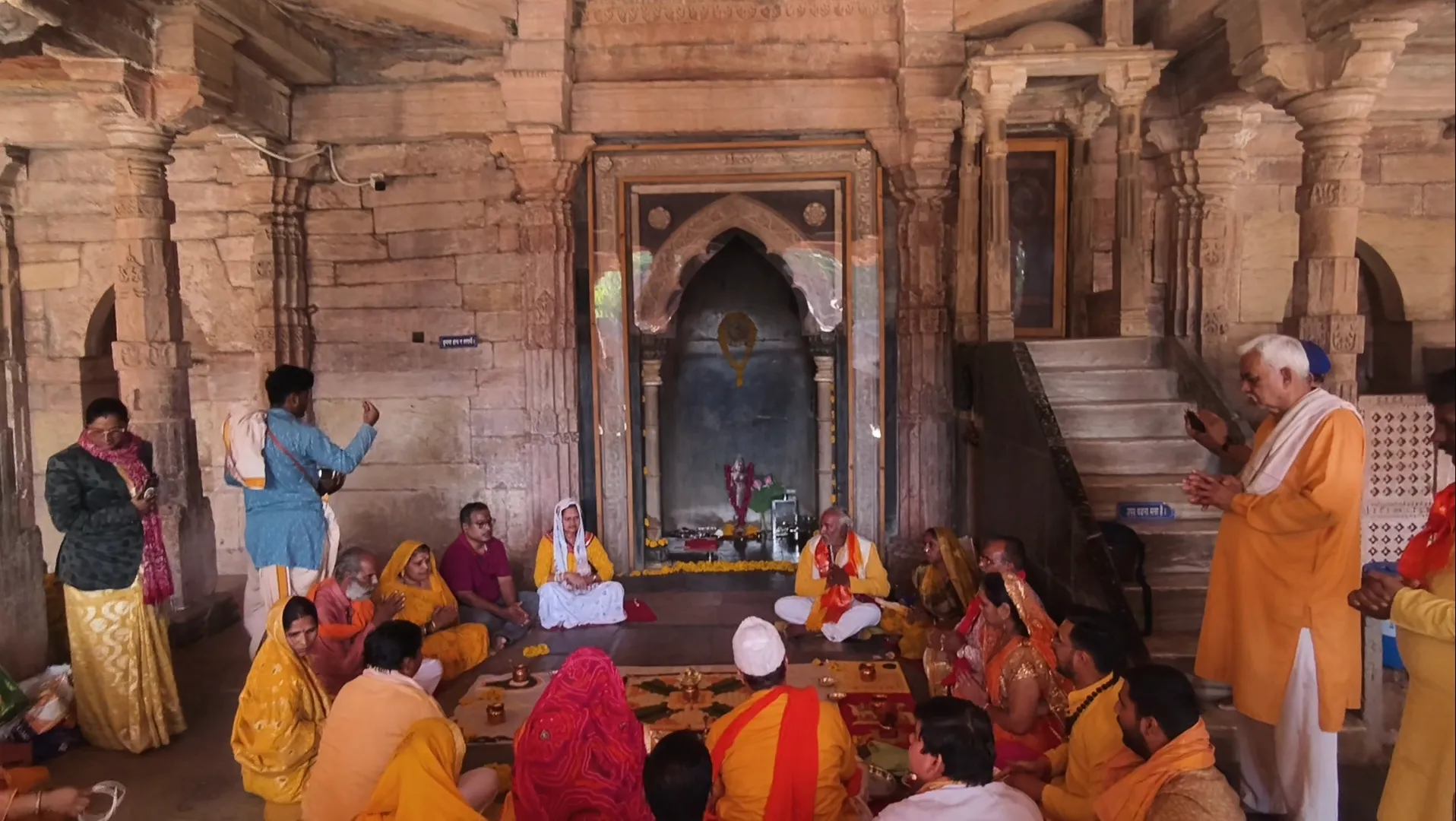
On Sunday, the 13th-14th century monument was awash in saffron flags — associated with “Hindutva”, the far-right Hindu supremacist movement — as young men danced to religious tunes, filming the rituals on their phones. Local activists installed a temporary idol of the goddess as Hindu worshippers gathered in large numbers amid heavy police deployment.
The Kamal Maula mosque in the nondescript town of Dhar is not alone. Far-right Hindutva activists have made similar claims — that a given mosque was built atop a temple — across India, emboldened by Prime Minister Narendra Modi’s rise to power in 2014.
Even the Taj Mahal, one of the world’s seven wonders, could not escape the Hindutva crusade to find temple origins beneath Islamic-era monuments. Though the Taj Mahal is a mausoleum rather than a mosque, its 17th-century Mughal roots have also made it a subject of dispute.
For millions of Muslims like Rafiq in India, this erasure of memory cuts deep. “Until last Friday, our mosque was ours; today it is not,” he said in a feeble voice. “I had never imagined in my dreams that something like this would happen.”
The site of the Kamal Maula mosque, or the so-called Bhojshala complex, has been disputed for decades, with the earliest Hindu nationalist claims made on the site in the late 1950s.
Under a 2003 agreement with the Archaeological Survey of India (ASI) — a government-run agency responsible for the protection of historical monuments — Hindus were allowed to visit the site every Tuesday, while Muslims were allowed to offer prayers on Fridays.
Now, the court’s ruling has declared the site a temple of Vagdevi, or the Goddess of Speech, allowing Hindus to worship at the site, and dismissing the Muslim community’s claim.
In its judgement, the court dismissed the petitions of the Muslim community, allowing them, however, to seek an alternative piece of land in the district to construct a mosque.
The court relied heavily on a survey of the monument by ASI two years ago. While the Hindu parties to the case hailed the verdict as historic, Muslims have pledged to challenge the ruling in the Supreme Court.
“Scholars are looking for methodology, rigour, and conclusions that meet international scholarly standards. Politically-motivated and substandard surveys carry little weight,” said Audrey Truschke, a historian with a focus on the Indian subcontinent, referring to the ASI exercises.
“The current trend of targeting mosques in India is part of the entrenched Islamophobia of Hindu nationalism,” she told Al Jazeera.
“It is one of many ways for Hindu nationalists to harass, threaten, and harm Muslim communities. India’s ongoing campaigns to restrict freedom of religion for Muslims are appalling,” Truschke added.
Advocates of the Muslim side and critics of the court’s ruling say the bench went an extra mile to award the site to Hindus.
In a formal gazetted notice, dated August 1935, reviewed by Al Jazeera, the then government officials wrote that there was no prohibition on Muslim prayers and it shall continue because the complex “is a mosque, and in the future also it shall remain a mosque”.
But the court did not accept the British-era notification, saying it predated the current laws.
The court also asked the Indian government to consider bringing back an idol of Vagdevi currently on display at the British Museum in London, as pleaded by the Hindu side, who claim that the idol belongs in the supposed temple on the disputed site.
The idol in question here is referred to as “Ambika”, another name for the goddess, carved in coarse white marble.
The British Museum’s description of the artefact notes that it is from the Paramara dynasty, as “found in the ruins of the City Palace in 1875” in Dhar by British Major-General William Kincaid.
“A map accompanying the description clearly shows that ‘Kamal Maula mosque’ is marked separately from the City Palace,” said Ashhar Warsi, a lawyer at the Madhya Pradesh High Court, who argued from the Muslim side in the case.
“Historical records clearly show that the idol was not found at the site of the Kamal Maula mosque, and the opposition is flat out lying,” Warsi told Al Jazeera.
Disgruntled over the verdict, Warsi added, “This is an erroneous judgement. It is a clear violation of the established rule of law.”
He referred to India’s Places of Worship Act, 1991, which freezes the religious character of all places of worship as they existed at the time of independence in August 1947. It essentially aimed to bar any new claims seeking to alter the nature of religious sites.
“The high court’s decision is absurd because the ASI has become the handmaiden of the Hindutva forces,” said Asaduddin Owaisi, a five-time member of parliament from the southern Indian city of Hyderabad.
“If the government of the day wants to convert all mosques [into temples], then it sends a message that there is a grave threat to the places of worship of the biggest minorities in India: Muslims,” Owaisi told Al Jazeera.
He further noted that the Madhya Pradesh High Court’s ruling “reeks with the stench” of the Supreme Court’s 2019 ruling on the demolition of the 16th-century Babri Mosque in Ayodhya town of the northern state of Uttar Pradesh.
“The Babri judgement opened the floodgates for all these claims and rulings to come up,” he said. “Where does this end? Certainly not on Dhar’s Kamal Maula mosque.”
India’s Hindu nationalist leaders led far-right mobs to demolish the 16th-century Babri mosque, claiming that it was built on the site of a temple during the first Mughal ruler, Babur, on land that was the birthplace of their chief deity, Ram.
Muslims offered prayers until 1949, when idols were placed inside the mosque allegedly by Hindu priests. The demolition triggered nationwide Hindu-Muslim riots that killed more than 2,000 people, most of them Muslims.
After years of bitterly fought legal battle, the Supreme Court controversially awarded the site to Hindus for the construction of the Ram Temple.
Prime Minister Modi sat over the consecration ceremony in January 2024, signalling a big victory in the Hindutva movement. He said the “wheel of time is turning back, and the days of Hindu pride are back”.
In fact, similar claims over other historic mosques have been a central plank of Modi’s BJP. After the Babri demolition, the party made chants of “Ayodhya keval jhaanki hai; Kaashi, Mathura baaqi hai” (Ayodhya is only a glimpse, Kashi and Mathura are next) central to its campaign, referring to two other towns in Uttar Pradesh where mosques have been claimed as temples.
Kashi, better known as Varanasi, is also Modi’s parliamentary constituency. In 2024, a Varanasi court ruled that the 17th-century Gyanvapi Mosque in the town had signs of a Hindu temple underneath it and allowed Hindus to pray inside it.
In Mathura, Hindu groups seek a repeat of Ayodhya by claiming that another Mughal-era mosque, the Shahi Eidgah, stands on the exact site where their god, Lord Krishna, was born.
Back in Dhar, as Hindu worshippers gathered at the disputed Bhojshala site on Sunday, the top district administration officials, including the senior-most police officer, sat down for the rituals celebrating the installation of Hindu idols.
Gopal Sharma, convener of a local Hindu organisation, also a party to the case, told Al Jazeera that Sunday’s rituals felt like a festival to him.
“For over 720 years, we have been waiting to restore the dignity of our goddess, who was humiliated and her temple torn down by Islamic rulers,” Sharma said. Al Jazeera could not find an independent historical source backing his claim that a Muslim ruler destroyed the supposed temple in the 1300s.
“This was not just a fight for a monument. This was a fight for Hindu civilisation. Since the Babri Mosque fell, it has stoked a sense of pride among Hindus. And that confidence is now leading us to establish the Hindu order in the country,” he said.
“The so-called religious harmony was tolerated for all these years on the pretext of secular politics in India. Now, secular politics does not run India any more. Modi’s Hindutva does.”
Owaisi said the Madhya Pradesh High Court took a leaf out of the Babri judgement when it ruled on the Kamal Maula mosque case. In both cases, he added, the court left the Muslim side with conciliatory alternative lands to build a mosque.
“The Babri judgement and this high court ruling have been decided based on popular faith, not evidence or justice,” he told Al Jazeera.
Source: https://www.aljazeera.com/features/2026/5/18/hindu-order-runs-india-court-declares-another-medieval-mosque-a-temple?traffic_source=rss
World
‘Hindu order runs India’: Court declares another medieval mosque a temple
Article Top Ad Zone
Article Middle Ad Zone
Article Bottom Ad Zone
Original Source: www.aljazeera.com
Share
Comments
Comment system is currently disabled.