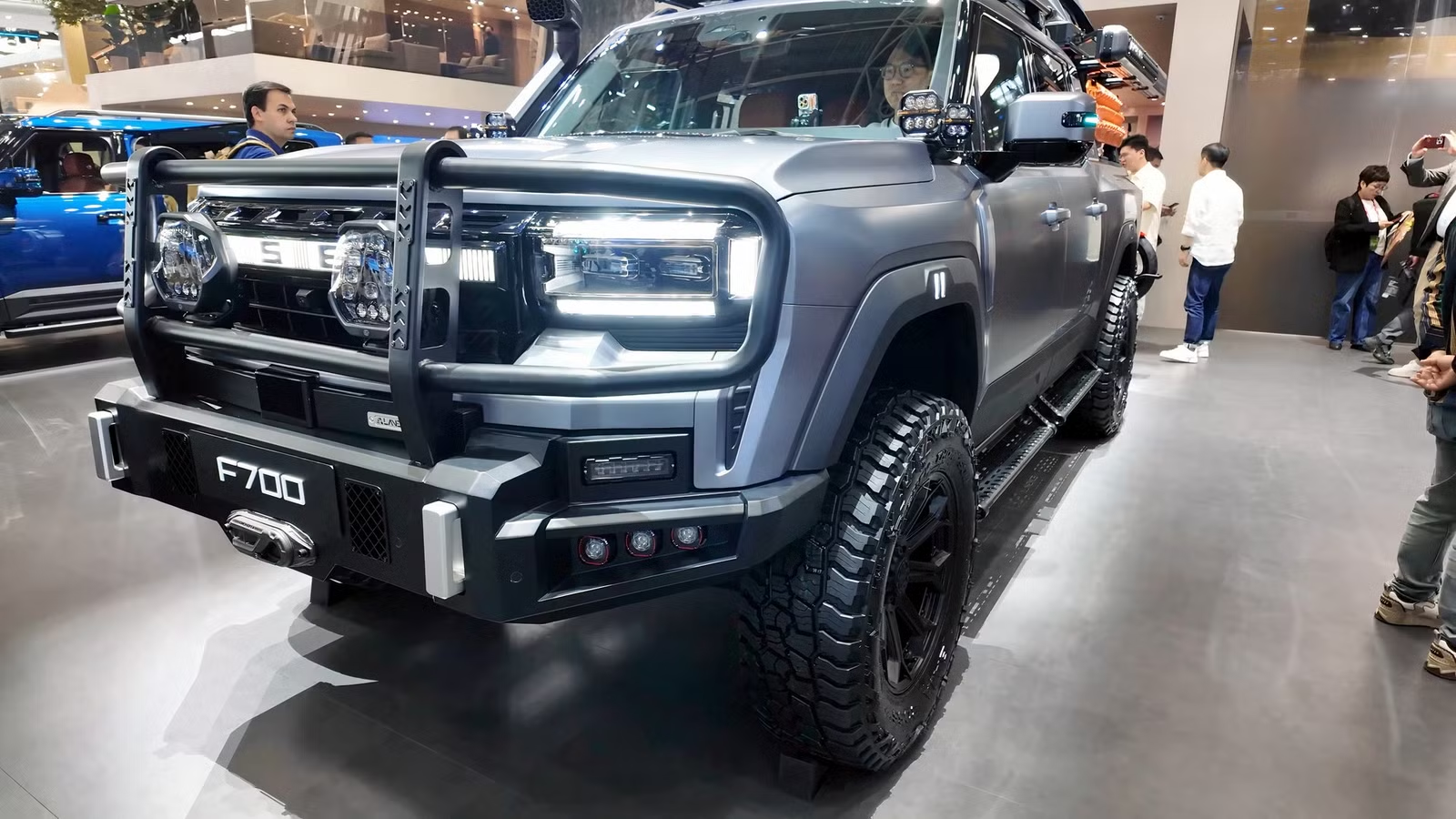
A Chinese automaker revealed a production quad-motor pickup this week packing 1,654 horsepower—a number that doesn't just top the halo-truck leaderboard, it laps it. The RAM 1500 TRX, long the benchmark for absurd American performance-truck excess, makes 645 hp from its supercharged 6.2-liter V8. The Ford F-150 Raptor R pushes that to 727 hp with its 5.2-liter supercharged V8. Neither is close.
The truck in question uses four electric motors—one at each wheel, or paired per axle—to produce a combined output that, on paper, belongs in a hypercar conversation rather than a pickup segment. Whether that translates to real-world performance or stays a spec sheet headline is the question every truck enthusiast is now asking.
Raw horsepower in an electric vehicle is delivered differently than in a supercharged V8. Electric motors produce maximum torque from zero rpm, which means a quad-motor truck at this output level would theoretically hit 60 mph in well under three seconds—a figure that would embarrass most purpose-built sports cars, let alone the TRX's already-quick 4.5-second sprint or the Raptor R's 4.4-second run.
Quarter-mile performance is harder to project without official figures, but a 1,654-hp EV truck with competent traction management and torque vectoring could realistically threaten the low-10-second range—territory currently occupied by purpose-built drag machines, not daily-driver pickups. The TRX runs the quarter in around 12.9 seconds in stock trim. The gap, if the Chinese truck's power is usable, would be significant.
Towing dynamics are a more complicated story. Peak horsepower matters less for trailer work than sustained output, cooling capacity, and torque curve management under load. A quad-motor platform does offer a genuine advantage in torque vectoring and stability when towing, but battery thermal management under sustained heavy load remains the central challenge for any high-output electric truck — and no official towing figures have been confirmed for this vehicle.
The performance-truck segment has been a two-horse race between Ford and Stellantis for most of the past decade. The original RAM 1500 TRX launched in 2021 as the most powerful mass-production pickup ever sold, and Ford answered with the Raptor R in 2023. Both trucks are supercharged, rear-biased, and built around the premise that a full-size pickup can also be a genuine performance machine.
This Chinese reveal forces a different kind of reckoning. The 1,654-hp figure isn't an incremental step—it's a category reset. It signals that Chinese automakers are no longer content to compete on value or feature-loading; they're targeting the halo end of global segments with specifications that Western manufacturers haven't approached. Whether that strategy translates to brand credibility or collector interest in key markets is a separate question, but the spec itself is real.
Almost certainly not in the near term. The current tariff environment surrounding Chinese-manufactured vehicles makes a U.S. import path for this truck effectively closed for the foreseeable future. Beyond tariffs, homologation, crash testing, and emissions certification for a vehicle at this specification level would require a significant investment that no Chinese automaker has yet committed to for the U.S. truck market specifically.
That said, the reveal still matters to American truck enthusiasts for two reasons. First, it establishes a new public benchmark that Ford and RAM engineers are aware of—even if neither company is likely to chase 1,654 hp in a near-term production truck. Second, it reflects a broader acceleration in global EV-truck development that will eventually influence what's available domestically, whether through technology transfer, competitive pressure, or market evolution. For now, the TRX and Raptor R remain the accessible performance-truck ceiling in the U.S.—but that ceiling just got a very public challenge from the other side of the world.
Source: https://www.topspeed.com/four-motors-1654-hp-china-new-pickup-outguns-ram-trx/
Cars
Four Motors, 1,654 HP: How China's New Pickup Outguns The TRX
Article Top Ad Zone
Article Middle Ad Zone
Article Bottom Ad Zone
Original Source: www.topspeed.com
Share
Comments
Comment system is currently disabled.