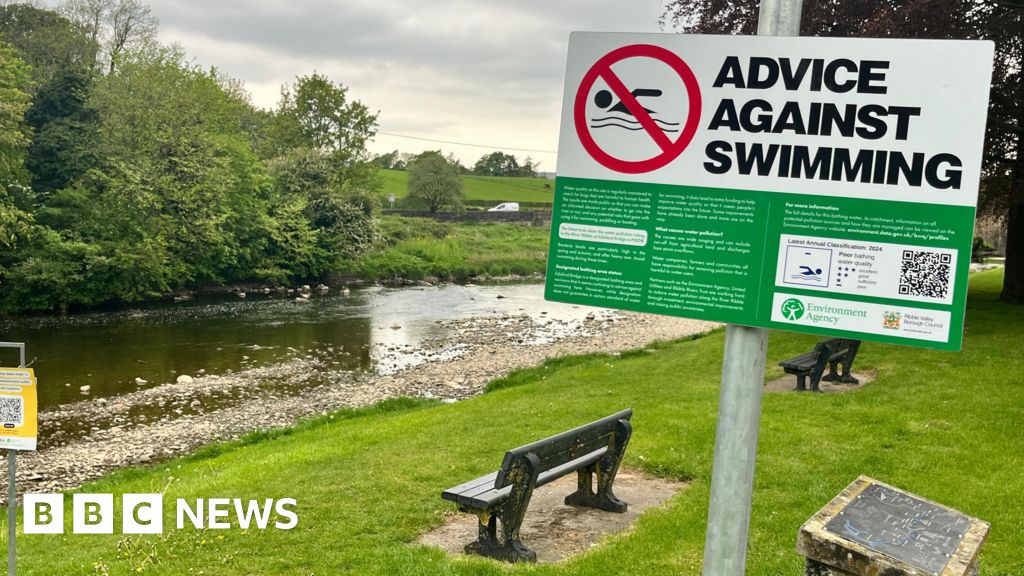
Signs warning people not to swim are in place at almost all of England's official river bathing sites due to concerns the water could be unsafe.
It comes as the government announces six new river bathing sites will be monitored for the first time this summer, including a first location on the River Thames in London.
In the last week the BBC has visited all the 14 existing inland river locations which were tested by the Environment Agency last year for contamination from bacteria linked to human and animal faeces.
Only the River Stour in Suffolk and the River Thames in Oxfordshire had acceptable levels, while water quality at the 12 others was rated "poor" and people advised not to swim.
The six new additions mean there are now more than 460 locations being regularly tested by the Environment Agency. The vast majority are coastal, but an increasing number are on lakes and rivers with the results from the tests posted on a government website.
In order to be designated as a bathing site the location must meet specific criteria including the number of bathers who use the site and whether there are nearby toilet facilities.
Water quality at coastal locations is generally much better than inland, with rivers frequently polluted by sewage discharges and agricultural run-off.
Campaigners say that getting a river designated - and the water testing regime it brings - has become one of the most effective ways to force water companies to take action to reduce sewage spills.
One campaigner called it "bonkers" that the best way to get a polluted river cleaned up was turn it into a popular site for swimming.
Annoucing the new sites, Water Minister Emma Hardy said: "The introduction of these new bathing sites means better monitoring of our waterways, a boost for local tourism, and greater confidence for local swimmers."
But water companies are less impressed at the growing number of monitored bathing sites.
"Designating an area as a bathing water before it is suitable for bathing and without a plan in place to clean it up risks confusing the public, who will rightly believe it is safe to swim there," a spokesman for Water UK, which represents the water companies, told the BBC.
The River Wharfe at Ilkley in Yorkshire was the first river to be designated as a bathing site in 2020 and as such is an important test case.
"When it rains, there can be tens of thousands of E.coli units per 100ml," Karen Shackleton from the Ilkley Clean River Group tells me.
E.coli is one of the bacteria linked to faeces which the Environment Agency tests for. Anything over 900 units per 100ml triggers advice to stay out of the water.
Fellow campaigner Di Leary points at the sewage overflow pipe on the other side of the river. "We're basically swimming in other people's poo," she says, before taking a quick dip.
The River Wharfe in Ilkley's has stubbornly rated "poor" every year since its first designation, but the campaigners are hopeful that's about to change.
Yorkshire Water is in the midst of a £60m investment programme it says will reduce the amount of sewage that flows into the river.
"This wasn't about wild swimming," Karen Shackleton says.
"It was actually about putting something in place so that the Environment Agency had to come and test the river, because they don't test rivers as standard. Then when they find the results that are poor, that drives the investment by the water company," she says.
Both agree there is a certain madness in a system that appears to encourage people to swim in a polluted river in the hope it will create the pressure to clean it up.
"It's very much a Catch 22 situation," Di says.
Karen nods: "It's disgustingly bonkers".
In Shropshire, Alison Biddulph has overseen the designation of three bathing sites, two on the River Severn at Ironbridge and Shrewsbury, and one on the River Teme at Ludlow.
All have so far rated "poor", which means there are signs up advising people not to swim.
But that doesn't put Alison off. When we meet she persuades me to join her in the water telling me she just stays out after heavy rain, which can trigger spills of raw sewage.
"I think it's probably going to take five years before you see any real difference, but we've already got a lot more focus on it," she says as we swim.
"The Environment Agency has put a sonde (a water testing device) in just downstream, and so they test the water quality every day, every hour. And for the water company it unlocks a whole package of money and different objectives for them to focus on," she says.
Source: https://www.bbc.com/news/articles/cvgzvqq9345o?at_medium=RSS&at_campaign=rss
World
'Don't swim' at 12 of 14 river bathing sites, as more locations announced
Article Top Ad Zone
Article Middle Ad Zone
Article Bottom Ad Zone
Original Source: www.bbc.com
Share
Comments
Comment system is currently disabled.