Bill ConnellyMay 23, 2026, 02:48 PM ETCloseBill Connelly is a writer for ESPN. He covers college football, soccer and tennis. He has been at ESPN since 2019.
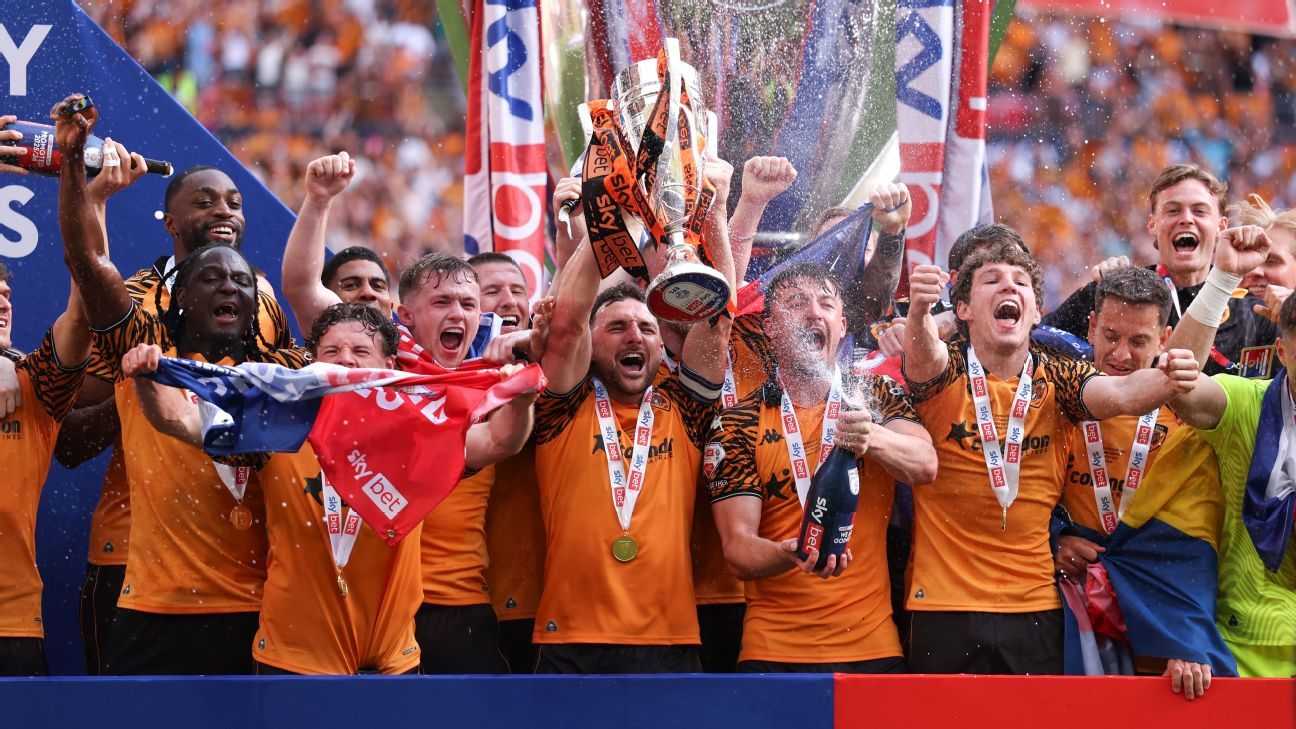
There are few joys in soccer greater than promotion -- especially promotion to the Premier League. Coventry City fans wept and waved signs saying "We're Back" after their team clinched this spring. There were bus parades as if the team had won the Champions League. And the celebrations were immense on Saturday after Hull City won what is famously the most lucrative single game of the year, the promotion playoff final at Wembley.
At some point, the euphoria of the moment gives way to great anxiety. Because reaching the Premier League and remaining in the Premier League are two completely different things.
In both 2023-24 and 2024-25, every promoted team that came up ... went straight back down. Two of those six doomed teams produced particularly dire point totals -- Southampton managed just 12 points in 2024-25, while Sheffield United had 16 in 2023-24 - but none of the six generated more than 26. It was pretty dire.
In 2025-26, two clubs offered hope. Leeds United played genuinely high-quality ball for much of the season, and despite poor finishing numbers, they will finish somewhere between 11th and 15th in the league; it's comfortably their second-best Premier League season of the last 20-plus years.
- Spygate explainer: Why Southampton were booted from Championship playoff - What Tottenham and West Ham need to happen to ensure their own Premier League survival - Liverpool vs. Bournemouth in a Premier League playoff? How historic 39th game could be played
Sunderland, meanwhile, have topped even that. Despite plenty of roster questions, they stormed out of the gate, losing just two of their first 11 matches and spending most of the season in the top half of the table. They head into Sunday's final matchday with a chance at both a top-half finish and their first finish above rival Newcastle United in 10 years.
Granted, it wasn't all good news for newcomers: Burnley, a yo-yo club for the 2020s, has made it five straight years of either getting promoted from the second division or getting relegated from the first. Still, two promotion success stories is more than we've gotten in a while.
Are there lessons to be learned, not only from Leeds and Sunderland but from the seven other clubs from the last decade who made the jump and remain in the Premier League? And what might those lessons mean for Coventry, Ipswich and Hull City?
Promotion year: 2017 Consecutive years in the Premier League: 9 Respective finishes: 15th, 17th, 15th, 16th, 9th, 6th, 11th, 8th, 7th (to date)
For quite a few teams in this sample, we see a period of pure survival followed by a period of growth. In Brighton's first four seasons of this eight-year run, they averaged just 1.04 points per game and 0.97 goals per game. But they've risen to become a genuine midtable force in the last four seasons, averaging 1.46 points and 1.52 goals since 2021-22. If they hold onto at least seventh place on Sunday, they'll play in a European competition next year for the second time in three seasons.
Having come into the Premier League with a roster full of players approaching their respective athletic primes, Brighton have since become known for developing strong young talent and making huge money off of player transfers Moisés Caicedo (€116 million to Chelsea), Marc Cucurella (€65.3 million to Chelsea), João Pedro (€63.7 million to Chelsea), Ben White (€58.5 million to Arsenal) and Alexis Mac Allister (€42 million to Liverpool), among others. But their strength early on was simply finding decent players approaching their prime and assuring they had a sturdy defensive base.
Promotion year: 2017 Consecutive years in the Premier League: 9 Respective finishes: 10th, 13th, 13th, 12th, 11th, 4th, 7th, 4th, 11th (to date)
While Newcastle have enjoyed a similar "survive, then thrive" theme to Brighton during their time back in the Premier League, they certainly got a boost when Saudi Arabia's Public Investment Fund (PIF) became their majority owner in October 2021. They had won only one of their first 18 league matches in 2021-22 and were mired in the relegation zone at the start of 2022, but some vigorous January transfer business resulted in a second-half surge and an 11th-place finish.
The Premier League's Profit and Sustainability Rules (PSR) have kept Newcastle's spending in check, while depth issues held them back a bit in the 2023-24 and 2025-26 seasons, in which they were also playing Champions League ball. (Something else that hurt: waiting until the tail end of last summer's transfer window before finally accepting that Alexander Isak wanted to leave.) But the effects of their spending have still been obvious: since PIF began writing transfer checks, they've averaged 1.7 points per game and have twice competed in the Champions League.
It doesn't feel like "find one of the richest benefactors in the world (and simply ignore the potential fallout from doing so)" should be a particularly useful lesson ... but depending on what happens moving forward, it might actually be just that?
Promotion year: 2019 Consecutive years in the Premier League: 7 Respective finishes: 17th, 11th, 14th, 7th, 4th, 6th, 4th (to date)
Aston Villa haven't benefited from a PIF-like money infusion, but owner V Sports has certainly opened its checkbook. Since being promoted in 2019, Villa have spent an average of €128.6 million per season in transfer fees, and while that threatened to put them in PSR jail -- which in turn forced them into a thriftier summer in 2025 -- it also re-established them in the world of European competitions. They reached the Conference League semifinals in 2023-24 and the Champions League quarterfinals in 2024-25 -- this week, they won the Europa League final in style. They'll be back in the Champions League next fall.
Others have tried the "spend a ton and hold on for dear life" approach with less success, but it certainly worked for Villa in recent years. (Tyrone Mings and Ezri Konsa were signed in 2019-20; Ollie Watkins, Emiliano Martínez and Matty Cash in 2020-21; Leon Bailey and Lucas Digne in 2021-22; Morgan Rogers, Youri Tielemans and Pau Torres in 2023-24; Amadou Onana and Ian Maatsen, plus Marcus Rashford and Marco Asensio on loan, in 2024-25.)
"Spend money well" is a key part to any success story, and Villa have done some good business. Their reward: cementing themselves in the top half of the table.
First 3 seasons in the Premier League: 1.18 points per game, 1.30 goals, 1.46 goals allowed Last 4 seasons: 1.70 points per game, 1.58 goals, 1.36 goals allowed
Champions League play and a major European trophy were hard to imagine as they were averaging a 14th-place finish from 2019-20 to 2021-22, but here we are.
Frank Leboeuf reflects on Unai Emery's impact following Aston Villa's Europa League victory, praising him for transforming the club's performances.
Promotion year: 2021 Consecutive years in the Premier League: 5 Respective finishes: 13th, 9th, 16th, 9th, 9th (to date)
The Bees didn't see first-division ball from 1947 to 2021, but they'll play their sixth consecutive season in the Premier League next year. They're still near the bottom of the league in terms of transfer spending, but one of the most analytics-friendly clubs in England has made up ground by simply knowing exactly what they are, identifying talent well and playing an intensely unique style of ball -- sacrificing shot quantity for quality, endlessly attempting 1-vs.-1s, keeping the possession count high, dominating on set pieces and just being willing to try stuff.
They were able to hold onto manager Thomas Frank for a long period of time, too, but when he left for Tottenham last summer, set piece coach Keith Andrews stepped right in and kept the good times rolling. And with each passing year, they've proven willing to take risks and keep games pretty open in the increasingly low-tempo Premier League.
First 2 seasons in the Premier League: 1.39 goals per game, 1.34 goals allowed Last 3 seasons: 1.56 goals per game, 1.51 goals allowed
After flirting with European football in recent years and potentially finishing in the top half of the table three times in four years, it will be interesting to see if and how Brentford approach trying to move further up. Ninth place is an incredible accomplishment, but clubs tend to eventually aim higher than that (and sometimes overextend themselves in the process). But for a club with a lower-division budget, the stability they've achieved of late is remarkable.
Promotion year: 2022 Consecutive years in the Premier League: 4 Respective finishes: 15th, 12th, 11th, 6th (to date)
After a brief Premier League stint in the mid-2010s (their first ever), the Cherries moved up for good (for now) in 2022. First they were lucky, and now they're good.
Like others on this list, Bournemouth were defensively excellent in the Championship, but they took an aggressive and athletic approach that doesn't always translate with an upgrade in competition: They allowed the fewest passes per defensive action (PPDA) and progressive carries, drew the second-most offsides and forced the third-most high turnovers. The transition to the Premier League didn't go particularly well either -- they were 20th in the league in xG differential and 19th in goal differential, but took just enough points from close games to survive by five points.
Bournemouth took advantage of the good fortune, bringing in manager Andoni Iraola from Rayo Vallecano and making outstanding young-player acquisitions for four straight years: Antoine Semenyo, Dango Ouattara and Illia Zabarnyi in 2022-23; Justin Kluivert and Milos Kerkez in 2023-24; Evanilson and Dean Huijsen in 2024-25; fullbacks Adrien Truffert and Álex Jiménez in 2025-26.
Iraola Ball has been unique, combining urgent attacking and the fastest tempo in the league with conservative defense that always keeps lots of players behind the ball. Bournemouth survived poachers in recent seasons, but with Iraola leaving after the season -- and European nights becoming a thing this fall and winter -- they'll have a new issue to deal with soon.
Gab & Juls explain how Bournemouth can qualify for the Champions League on the final day of the Premier League season.
Promotion year: 2022 Consecutive years in the Premier League: 4 Respective finishes: 10th, 13th, 10th, 13th (to date)
Up in 2018, down in 2019, up in 2020, down in 2021. Fulham were the patented yo-yo club for a few years, but with help from recent years of Premier League money, they got their infrastructure in place and finished first in the Championship in 2021-22. The attack was incredible, finishing a distant first in goals (2.3 per match) and first in expected goals (xG) with 2.1. Perhaps most interestingly, they were first in both buildup attacks -- open-play sequences that contain at least 10 passes and either end in a shot or produce a touch in the opponent's box -- and in xG created from counterattacks. They could attack you with either patience or urgency.
The main pieces of this amazing attack were Aleksandar Mitrovic (50 combined goals and assists in 2021-22), Harry Wilson (29), Fábio Carvalho (18), Bobby De Cordova-Reid (15) and Neeskens Kebano (15). Only Wilson is still with the club and, amazingly, manager Marco Silva still is as well. For now. He was there for the promotion season, and after four steady campaigns -- including a 2025-26 season that featured very little in the way of transfer spending (comparatively speaking) -- his name has been linked to major-club vacancies like Benfica.
Silva hasn't crafted a hard-coded identity at Craven Cottage the way that Iraola has at Bournemouth, but he's an excellent manager. His absence would make life tricky in 2026-27.
Promotion year: 2022 Consecutive years in the Premier League: 4 Respective finishes: 16th, 17th, 7th, 16th (to date)
Forest are the ultimate "survive, then thrive" team. Or maybe they're the ultimate "survive, then thrive, then survive again" team. They haven't really created a model you'd feel comfortable following, signing 45 players (including loanees) in their first two seasons, dealing with a points deduction from the financial rules they stretched while doing it, living most of two seasons under relegation threat before finding their footing and then finding themselves in danger again once European play entered the equation. But they survived a season with three coach firings this year -- Nuno Espirito Santo (who led them to Europe last season) in September, Ange Postecoglou in October, Sean Dyche in February -- and they'll end it looking pretty comfortable with Vitor Pereira.
If there is any such thing as "comfortable" with big-spending and impulsive owner Evangelos Marinakis.
At their best, Forest have combined a strong defensive core, established by players like goalkeeper Matz Sels and center-backs Murillo and Nikola Milenković, with speedy creatives like Morgan Gibbs-White and the old-school scoring presence of Chris Wood. With Wood aging and Gibbs-White being courted by bigger clubs, we'll see what their core looks like moving forward. But with four years of survival, plus a fun trip to the Europa League semifinals this spring, this has somehow been a semi-success story to date.
Promotion year: 2025 Consecutive years in the Premier League: 1 This year's finish: 14th (to date)
Don't let the 14th-place finish fool you: Leeds have been legitimately impressive for about the last six months.
"Since Dec. 3 -- an arbitrary starting point, but one that creates a reasonably significant sample of 22 to 23 matches for Premier League teams -- Leeds are seventh in the league in points per game, sixth in xG differential and fifth in goal differential. In this span, only Arsenal and Liverpool have scored more from set pieces (and no one's attempted more shots from them), only Bournemouth have made more defensive interventions, only Manchester City have started a higher percentage of possessions in the attacking third, only Brighton have created more high turnovers, and no one has scored more goals from high turnovers. No one has attempted more aerial duels either. Daniel Farke's team have mastered a unique blend of pressing, directness and old-school crosses and ball-into-mixer tactics"
The club committed a heavy net spend coming into the season, keeping all of its young talent and laying down €113.7 million in transfer fees to bring in 11 newcomers; six of the new signings started at least half of Leeds' Premier League matches -- led by veteran forward Dominic Calvert-Lewin and chief creator Anton Stach -- and four others became at least bit players. Nailing a transfer window is a surefire way to give yourself a chance, and Leeds got wonderful value out of their transfer haul. Combine that with Farke's newfound adaptability, and you have a year-one success story.
We'll see what they pull off for year two.
Promotion year: 2025 Consecutive years in the Premier League: 1 This year's finish: 10th (to date)
Like Bournemouth at first, Sunderland have been lucky in 2025-26. Though they are 10th in the table, their underlying numbers suggest a lower level of play: They're 17th in goals scored, 15th in goal differential and 18th in xG differential. They expended loads of energy early on and were guaranteed to fade later in the season (and did), but they turned that energy into a run of lovely early results -- 2-1 over Brentford in August, 2-1 over Chelsea in October, 3-2 over Bournemouth in November, plus, of course, a clean Tyne-Wear derby sweep of Newcastle -- and they stockpiled enough points that they were never in serious danger.
Their defense has wobbled significantly in the new year: In the last 17 matches, they've allowed at least three goals six times. But all of this is secondary to survival. They entered last summer with by far the lowest-grade roster and the highest odds of relegation, and they brought in a haul of 18 newcomers, 10 of whom were 23 or younger, who have been asked to contribute 75% of the club's minutes.
Between veterans like midfielder Granit Xhaka and right back Nordi Mukiele, approaching-prime players like attacking midfielder Enzo Le Fée and forward Brian Brobbey and 21-and-unders like midfielder Noah Sadiki, they found a workable core. And while the regression monster looms, they'll be back in the league next season.
There aren't many surefire similarities among the nine clubs above. It certainly seems like building a sturdy and reliable defense (one more likely to rely on soaking up pressure than delivering it) is cheaper than building a dynamic attack, and hey, if you can find yourself an owner willing to spend hundreds of millions of pounds in transfer fees, year after year, and test financial limitations, then go for it. But plenty of recently relegated teams have also attempted to spend loads of money, and plenty thought they had sturdy defensive personnel.
Still, while acknowledging that this season's new success stories both signed large transfer hauls and benefited greatly from them -- and we therefore won't know what we need to know about next season's promoted teams until we see who they sign -- let's take a look at the new batch of Coventry City, Ipswich Town and Hull City. How have they been built, and who might have the most sustainability potential?
After collapsing all the way to England's fourth division in 2016-17 thanks to debts and faulty hedge-fund ownership, Coventry quickly rebounded under competent new owners. They made it back to the third division in 2017-18 and to the second in 2019-20, and after a couple of mediocre seasons in the Championship, they made a sustained run at promotion, reaching (and losing in) the Championship playoffs with fifth-place finishes in both 2022-23 and 2024-25 before rolling to 95 points and the second-division title this season.
This year, Coventry were comfortably the best team in the league: First in goals scored (97), first in goals allowed (45), and first in scoring margin, both in open play (+34) and on set pieces (+16). Frank Lampard found a fun mix of possession principles (fourth in possession rate), directness (third-most direct attacks, sequences starting in the defensive half and producing a shot within 20 seconds) and the highest defensive line in the league (first in offsides drawn).
The secret to Coventry's success has been a stable core. Lampard has been the manager since November 2024, and newcomers only contributed 17% of the team's league minutes this season. Most of that came from goalkeeper Carl Rushworth. This is a very mature (but not downright old) roster core: In terms of minutes played, their top 17 players are all between the ages of 24 and 30. American Haji Wright (28) is their leading scorer, left winger Ephron Mason-Clark (26) might be their best creator, and center-backs Bobby Thomas (25) and Liam Kitching (26) and Rushworth (24) have been excellent in the back. Coventry don't have much in the way of hot young prospects -- the closest things are probably right back Milan van Ewijk (25) and attacking midfielder Jack Rudoni (24) -- but this is an experienced roster that could produce a pretty high floor for performance.
High ceiling? We'll see. But it will be interesting to see what kind of investment the club feels it needs to make this summer.
Ipswich started the season in a post-relegation funk. After reaching the top division for the first time in 23 years, they won only four Premier League matches in 2024-25 and went straight back down. With only four of their top 13 regulars from their Premier League squad -- center-backs Dara O'Shea and Jacob Greaves, left back Leif Davis and defensive midfielder Jens Cajuste -- and a brand new core of attackers, they began 2025-26 with just two wins in their first seven Championship matches.
From about October 1 onward, Kieran McKenna's Tractor Boys figured things out: Over the final 39 matchdays, Ipswich were third in goals scored and second in goals allowed. The secret to their success? Raw aggression, mostly without the ball. They allowed the fewest progressive passes, progressive carries and overall touches in the box, and they were second in shots allowed per possession. They kept the ball out of dangerous areas and engineered a solid number of quick strikes and high-value scoring opportunities. Their attack was a collective one, with five players -- Jack Clarke, George Hirst, Jaden Philogene, Marcelino Núñez and Iván Azón (none of whom played more than 58% of the club's minutes) -- contributing between nine and 17 combined goals and assists.
Ipswich's depth of attackers could pay off when they return to the Premier League, but the intensity of their established style will still probably require them to sign quite a few new players this summer if they want to survive. They weren't able to create nearly enough opportunities from defensive pressure in 2024-25, and they probably don't have enough raw quality in attack without that. They face a big summer.
If you're a fan of underdogs, I have great news for you: Hull City might be one of the biggest underdogs in Premier League history next season. They somehow advanced to the promotion playoffs with a sixth-place finish despite producing an xG differential of minus-19.9, second-worst in the entire second division.
They turned shots worth 60.4 xG into 70 goals in league play (overachievement of 15.9%), and they somehow allowed only 66 goals from shots worth 80.3 (overachievement of 17.8%). On six different occasions, they won matches despite an xG differential worse than minus-1.0, and they tied three others as well. In terms of pure chance quality created and allowed, they were a worse team than Leicester City and Oxford United, both of whom were relegated.
It's not their fault that opponents weren't clinical enough, though! In three promotion playoff matches, they allowed shots worth 2.4 xG and gave up zero goals. Oli McBurnie's breakaway goal in the fifth minute of second-half stoppage time earned them a win at Wembley.
It's a truly incredible story, but we understand the odds of what happens next. Hull kept matches deliriously wide open in 2025-26: They were second in the league in xG per shot and second-worst in the league in xG allowed per shot. They allowed the fourth-most progressive passes and the third-most shots per possession, and they counter-attacked with abandon and attempted as many duels as humanly possible.
They scored the most goals from ball recoveries, and they allowed the third-most goals from high turnovers. If they attempt the same style in the Premier League, with the same personnel, they will get shredded in a way I'm not sure we've ever seen before. I can't tell you how many people I've already seen online referencing Derby County's famous 11-point campaign of 2007-08, the worst ever in the Premier League.
Of course, Sunderland were supposed to be overwhelmed this season as well. If Hull nail their transfer signings, figure out how to curb their wildest tendencies and steal available points the way they did this season, they might give themselves a chance of survival. But it's obvious who faces the longest odds out of the gate.
Source: https://www.espn.com/soccer/story/_/id/48851763/premier-league-promotion-relegation-coventry-city-ipswich-town-hull-city
Football
Congrats, you're promoted to the Premier League! N...
Article Top Ad Zone
Article Middle Ad Zone
Article Bottom Ad Zone
Original Source: www.espn.com
Share
Comments
Comment system is currently disabled.