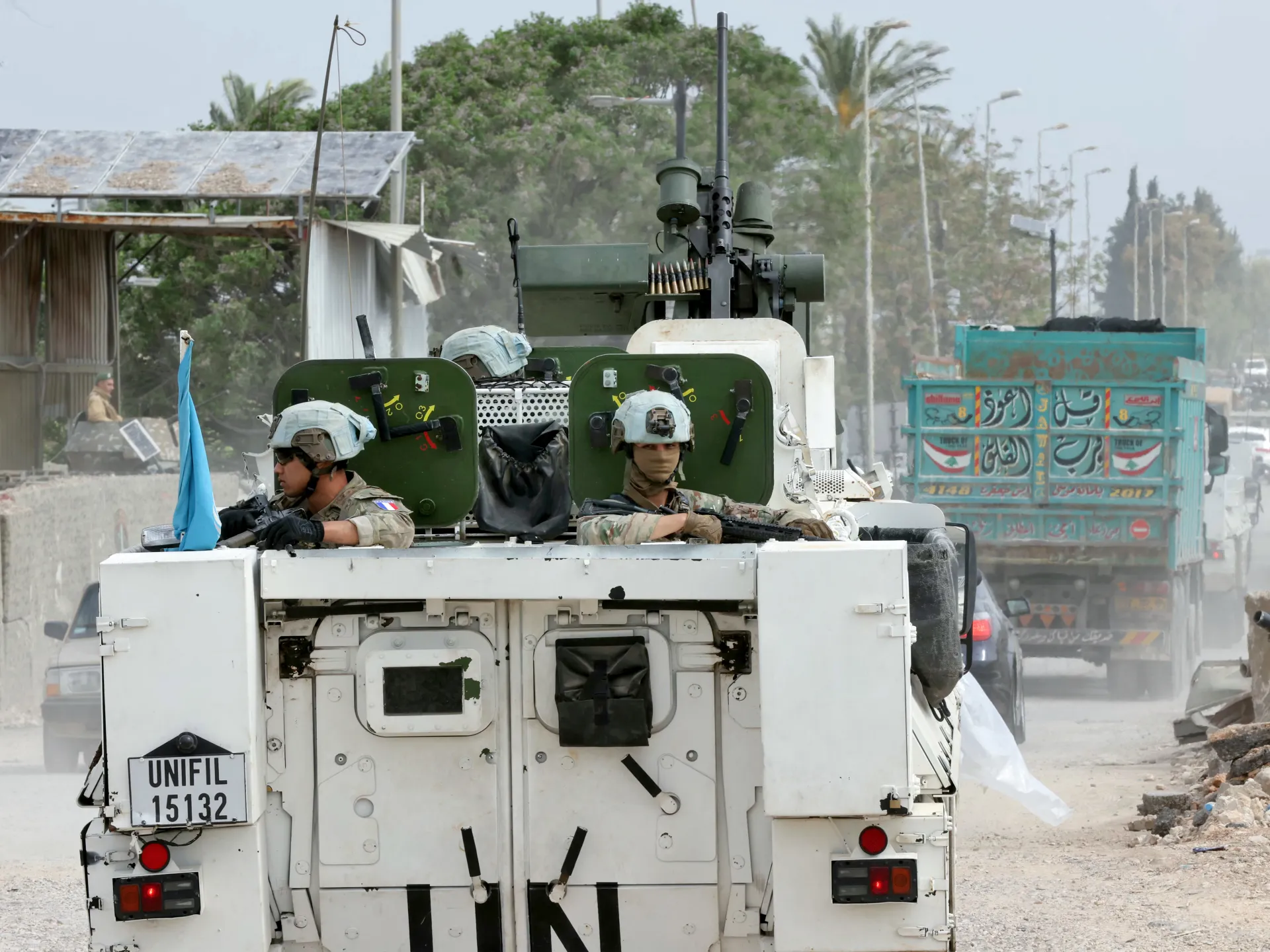
Israel has pushed past the Litani River, with the UNFIL peacekeeping force helpless in preventing an invasion.
Beirut, Lebanon – The mandate of the United Nations Interim Force in Lebanon (UNIFIL) ends on December 31, 2026, bringing to an end its 48-year peacekeeping role.
This week, Israel advanced deeper into Lebanese territory than at any point since it ended a nearly two-decade occupation of the country’s south in 2000. The UN body’s inability to prevent the invasion has led to questions about UNIFIL’s mandate and its effectiveness in keeping the peace.
UNIFIL has been attacked by both Israeli and Lebanese actors for various perceived failures. The Israelis often criticise the UN force for failing to disarm Hezbollah or other nonstate armed actors, although Resolution 1701 – the UN mandate for the body in Lebanon – does not stipulate this.
Conversely, UNIFIL has also been accused of working against Lebanese armed groups that are fighting Israel.
“Israel has long accused UNIFIL of failing to prevent Hezbollah’s military presence and rearmament, while Hezbollah and its supporters have often accused UNIFIL of acting in ways that serve Israeli intelligence and security interests,” Imad Salamey, a Lebanese political analyst, told Al Jazeera.
“Both criticisms contain elements of political messaging as much as operational assessment, with each side seeking to shape public opinion and strengthen its own narrative regarding security, sovereignty, and responsibility for the conflict.”
Israel intensified its war on Lebanon on March 2, just hours after Hezbollah fired on Israel for the first time in over a year, starting a chain of new disasters for the Lebanese.
Hezbollah said it was simply responding to more than a year of Israeli attacks on Lebanon and seeking retaliation for the US-Israeli assassination of Iran’s Supreme Leader Ayatollah Ali Khamenei.
Israel, which already occupied five points in southern Lebanon despite a 2024 ceasefire agreement, then proceeded with a new invasion of Lebanon – its most brazen in decades.
Since March 2, Israel has killed 3,412 people in the country, according to the Lebanese Ministry of Health, and displaced over 1.2 million, some multiple times.
Even before the latest Israeli assault, Israel had violated the 2024 ceasefire more than 10,000 times, according to the UN.
In southern Lebanon, where UNIFIL operates, towns and villages have been razed to the ground since the start of the war between Israel and Hezbollah in October 2023. The speed and severity of the destruction have intensified since the new Israeli assault in March, despite a ceasefire and multiple extensions.
UNIFIL was established amid the first Israeli invasion of Lebanon in 1978. Israel re-invaded Lebanon in 1982 and stayed until 2000, when it was forced out following strong resistance from groups, notably Hezbollah, in the south.
UN Resolution 1701 calls for a cessation of hostilities between Hezbollah and Israel and for the Lebanese government and UNIFIL to deploy forces to southern Lebanon. The enforcement of the resolution was also mentioned during negotiations around the 2024 ceasefire agreement. UNIFIL has not been given a mandate to use force against Hezbollah, Israel, or other state or nonstate actors, unless in self-defence.
“Over the past three years, UNIFIL’s role has largely been one of monitoring, observation, liaison, and reporting rather than enforcement,” said Salamey. “The very name ‘United Nations Interim Force in Lebanon’ has often created expectations that it was a peace enforcement mission capable of preventing hostilities, when in practice it operated under significant political and operational constraints.”
UNIFIL’s mandate has evolved over the years. After the July 2006 war between Hezbollah and Lebanon, its responsibilities were to implement obligations under UN Resolution 1701, Tilak Pokharel, UNIFIL’s public information officer, told Al Jazeera.
Currently, Pokharel said, UNIFIL is still executing its responsibilities, but with impediments from both actors in hostilities. Israel has damaged or destroyed roads and established roadblocks, while Hezbollah has set up landmines on certain roads, he said.
“Our activities have been heavily constrained and limited… because of the situation,” Pokharel said.
UNIFIL peacekeepers have also come under attack multiple times since the resumption of conflicts. In April, a French soldier was killed while out on patrol, with authorities in Paris blaming Hezbollah. Three other peacekeepers were wounded in the village of Ghandouriyeh in April as well.
Israel has surrounded UNIFIL bases at times and, at one point, removed cameras positioned outside one of the facilities. “Let’s be honest,” a diplomatic source told Al Jazeera. “They didn’t want witnesses.”
On Tuesday, Lebanon and Israel are set to resume direct negotiations at the US State Department in Washington, DC. The two countries’ militaries reportedly met on Friday in preparation for Tuesday’s talks.
But the forthcoming discussions have not eased the situation on the ground. Israel continues to push forward with its invasion of southern Lebanon, announcing it had taken over the 900-year-old Beaufort Castle on Sunday.
Israel had issued forced evacuation orders for two major southern towns in recent days, and on Monday, Israel’s Prime Minister Benjamin Netanyahu said he had approved attacks on Beirut’s southern suburbs, known as Dahiyeh.
Pokharel said Sunday also marked a severe escalation in the south, as UNIFIL counted the highest number of violations and trajectories crossing from both sides of the border since April 17, when US President Donald Trump announced that a ceasefire was set to come into effect.
Despite the ongoing war, European diplomats have said there is strong support in Europe and Lebanon to continue some form of monitoring body in the country once UNIFIL begins to scale down and end its operation at the end of the year.
At its peak, UNIFIL had around 15,000 units in the south. But financial cutbacks mean that little over 7,000 are currently present. Pokharel said that around 3,000 units left without being replaced in the last six months or so. While the Lebanese government and many members of the international community wanted UNIFIL’s mandate extended, the United States voted against it.
“The US took the stance adopted by the Israelis,” one European diplomat said. “We are worried about a vacuum.”
A variety of options have been proposed as an alternative, including a scaled-down UN force under the United Nations Truce Supervision Organization (UNTSO), which has been present in the country since 1947. This organisation, though, reportedly only has around 50 personnel.
Diplomats have said that a number of European, African and Asian countries have volunteered to contribute manpower to whatever body takes UNIFIL’s place in 2027 and beyond.
But analysts say that UNIFIL, or a replacement, cannot effectively bring peace to southern Lebanon alone. For that, a political consensus in Lebanon and the wider region is necessary.
Many observers believe Lebanon’s fate is closely tied to peace negotiations between the US and Iran, the primary benefactor behind Hezbollah. Trump has repeatedly said a deal is close, though the ceasefire between the two sides has been tested on a number of occasions, including on Monday, when US ally Kuwait said Iran had attacked it.
“No international force is likely to successfully enforce a ceasefire, impose disarmament, or maintain long-term stability unless there is a broader political consensus both within Lebanon and across the region,” Salamey said.
“Ultimately, durable stability depends less on the design of an international force and more on a regional framework in which Israel accepts a genuine peace based on mutual recognition of sovereignty and self-determination, including a just resolution of the Palestinian question, while Lebanon achieves internal consensus over state authority and the monopoly of arms.”
Source: https://www.aljazeera.com/features/2026/6/1/as-israel-pushes-past-the-litani-lebanese-question-the-purpose-of-unifil?traffic_source=rss
World
As Israel pushes past the Litani, Lebanese question the purpose of UNIFIL
Article Top Ad Zone
Article Middle Ad Zone
Article Bottom Ad Zone
Original Source: www.aljazeera.com
Share
Comments
Comment system is currently disabled.