Lexus didn’t become one of the world’s most trusted luxury brands by accident. While many automakers chase outright performance and cutting-edge technology, Lexus has traditionally taken a more measured approach. The Japanese luxury marque has built its reputation on refinement, durability, comfort, and long-term ownership satisfaction rather than headline-grabbing gimmicks.
Follow and Like top authors, topics, and trends
Browse with fewer ads across the site
Personalize your profile to showcase your activity
Get a content feed tailored to your interests
By creating an account, you agree to our Terms of Use and Privacy Policy. You also agree to receive our newsletters; you can unsubscribe any time.
*Required: 8 chars, 1 capital letter, 1 number
That reputation continues to be supported by the data. According to the latest J.D. Power Vehicle Dependability findings, Lexus remains one of the strongest premium brands for long-term reliability. But not every Lexus model performs equally when it comes to reliability. Some rely on proven platforms and long-established engineering, while others introduce newer technologies and powertrains that may still need time to prove themselves. Using J.D. Power data findings and long-term ownership trends, here are the Lexus models ranked from least dependable to most reliable.
Models are listed in ascending order based on reliability scores from JD Power, from the least reliable to the most reliable. Models that have not been rated are listed at the beginning.
The Lexus RZ is Lexus’ first dedicated electric SUV and one of the newest vehicles in the lineup. Built on Toyota’s e-TNGA electric platform, the RZ combines futuristic styling with Lexus’ trademark comfort and refinement. The exterior features a sleek spindle-inspired front fascia, sculpted bodywork, and sharp LED lighting.
Inside, the cabin adopts a more minimalist approach than traditional Lexus models, while still offering premium materials, ambient lighting, large infotainment screens, and excellent sound insulation. For the U.S. market, the lineup currently includes the front-wheel-drive RZ 300e producing 201 horsepower and 196 pound-feet of torque, while the all-wheel-drive RZ 450e delivers 308 horsepower and 320 pound-feet of torque. Depending on trim, wheel size, and drivetrain, range varies between roughly 220 and 301 miles.
The Lexus RZ is still relatively new, and there is not yet enough long-term ownership data available to accurately assess reliability trends. However, Consumer Reports predicts above-average reliability, while Lexus’ engineering reputation gives the RZ a strong foundation moving forward.
Average Yearly Maintenance Cost: Not enough EV-specific long-term data yet
Estimated Maintenance Cost During The First 10 Years: Expected below segment average
Worst Year To Buy Used: 2023 (launch-year software issues)
The Lexus LS represents the pinnacle of Lexus luxury, combining craftsmanship, comfort, and advanced technology in a flagship sedan package. Powered by a 3.4-liter twin-turbocharged V6 producing 416 horsepower and 442 pound-feet of torque, the LS delivers smooth and effortless performance.
Its elegant styling and ultra-premium interior place it firmly against rivals such as the Mercedes-Benz S-Class and BMW 7 Series. Despite its added complexity and advanced technology, Lexus’ conservative engineering philosophy helps the Lexus LS maintain a strong reputation for durability compared to many European flagship sedans.
Average Yearly Maintenance Cost: Around $870
Estimated Maintenance Cost During The First 10 Years: Around $9,500
Worst Year To Buy Used: 2007 (air suspension and electronics)
The latest-generation Lexus GX modernizes the brand’s rugged SUV formula while maintaining the body-on-frame construction that made previous generations so respected. Powered by a 3.4-liter twin-turbocharged V6 producing 349 horsepower and 479 pound-feet of torque, the GX combines serious off-road capability with improved on-road refinement.
Its bold styling leans heavily into adventure-inspired design, while the interior blends practicality with luxury through modern infotainment systems and premium materials. The Lexus GX competes with rivals such as the Land Rover Defender and Toyota Land Cruiser, though Lexus continues to differentiate itself through durability and lower ownership stress. While long-term data is still limited for the latest model, its Toyota engineering roots suggest it should remain one of the toughest SUVs in the segment.
Average Yearly Maintenance Cost: Around $770
Estimated Maintenance Cost During The First 10 Years: Around $8,500
Worst Year To Buy Used: 2004 (secondary air injection failures)
This hybrid might capitalize on reliability, but its low ownership costs and luxury are some added bonuses.
The Lexus UX focuses on simplicity, efficiency, and urban usability. Most U.S. models use a 2.0-liter hybrid powertrain producing a combined 181 horsepower and 139 pound-feet of torque, prioritizing fuel economy and smoothness over outright performance. Its compact dimensions make it easy to drive in city environments, while the interior remains impressively well-built for the segment.
Lexus has focused heavily on refinement, with quality materials and strong noise insulation helping the UX feel more premium than some rivals. Vehicles such as the Volvo XC40 and BMW X1 may offer stronger performance, but the UX counters with better efficiency and stronger long-term dependability thanks to Lexus’ proven hybrid systems.
Average Yearly Maintenance Cost: Around $550
Estimated Maintenance Cost During The First 10 Years: Around $6,500
Worst Year To Buy Used: 2019 (first-year electrical bugs)
The Lexus TX was developed to meet growing demand for spacious three-row luxury SUVs. The TX 350 uses a 2.4-liter turbocharged four-cylinder engine producing 275 horsepower and 317 pound-feet of torque, paired with an eight-speed automatic transmission. The TX Hybrid improves on the standard TX by integrating Lexus’ long-established hybrid expertise. The TX 500h pairs a 2.4-liter turbocharged four-cylinder engine with an electric motor system to produce a combined 366 horsepower and 406 pound-feet of torque.
Its focus is comfort, practicality, and family-friendly luxury rather than outright sportiness. Three spacious rows and improved cargo versatility make it particularly attractive to growing families. The TX competes against vehicles such as the Acura MDX and Audi Q7. While still relatively new to the market, early reliability data appears encouraging, and Lexus’ broader dependability reputation adds confidence.
Average Yearly Maintenance Cost: Not enough long-term data yet
Estimated Maintenance Cost During The First 10 Years: Around $7,500
Worst Year To Buy Used: 2024 (first model year)
The Lexus RX remains one of the brand’s most important and best-selling models. The current lineup offers a range of turbocharged and hybrid powertrains, including the RX 350’s 2.4-liter turbocharged engine producing 275 horsepower and 317 pound-feet of torque, while hybrid variants such as the RX 500h deliver up to 366 horsepower.
Its design has evolved into a more athletic-looking SUV, while the interior continues to prioritize comfort, usability, and refinement. The RX competes with rivals such as the BMW X5 and Mercedes-Benz GLE, though it differentiates itself through smoothness and long-term dependability. Consistent performances in both J.D. Power and Consumer Reports studies continue to reinforce the Lexus RX’s reputation as one of the most dependable luxury SUVs available.
Average Yearly Maintenance Cost: Around $550 (RepairPal Lexus average)
Estimated Maintenance Cost During The First 10 Years: Around $7,500–$8,000 (CarEdge estimate)
Worst Year To Buy Used: 2007 (oil cooler line failures)
Discover the best model years of Lexus' luxury off-roader.
The Lexus NX blends bold styling, modern technology, and multiple drivetrain options into a compact luxury SUV package. Engine choices range from a naturally aspirated 2.5-liter four-cylinder producing 203 horsepower to a turbocharged 2.4-liter engine delivering 275 horsepower and 317 pound-feet of torque.
Hybrid and plug-in hybrid variants are also available, giving buyers more flexibility than many rivals. The Lexus NX competes against vehicles such as the BMW X3 and Audi Q5. While the added technology and drivetrain variety introduce more complexity compared to simpler Lexus models, the NX still benefits from the brand’s strong engineering foundations and positive dependability ratings.
Average Yearly Maintenance Cost: Around $690
Estimated Maintenance Cost During The First 10 Years: $7,712 (CarEdge)
Worst Year To Buy Used: 2015 (early infotainment and transmission complaints)
The Lexus ES has long been regarded as one of the safest luxury car purchases for buyers prioritizing long-term ownership satisfaction. Rather than focusing on sporty driving dynamics, the ES prioritizes comfort, simplicity, and refinement. Powertrain choices include a 203-horsepower four-cylinder engine, a 302-horsepower V6, and a hybrid system producing a combined 215 horsepower. Each setup focuses on smoothness and efficiency rather than aggressive performance.
Compared with rivals such as the Acura TLX and Volvo S90, the ES may not feel as sporty or technologically ambitious. However, its proven platform and straightforward engineering continue to make it one of the easiest luxury sedans to own long-term.
Average Yearly Maintenance Cost: $468 (RepairPal)
Estimated Maintenance Cost During The First 10 Years: $5,945 (CarEdge)
Worst Year To Buy Used: 2007 (dashboard melting and oil line issues)
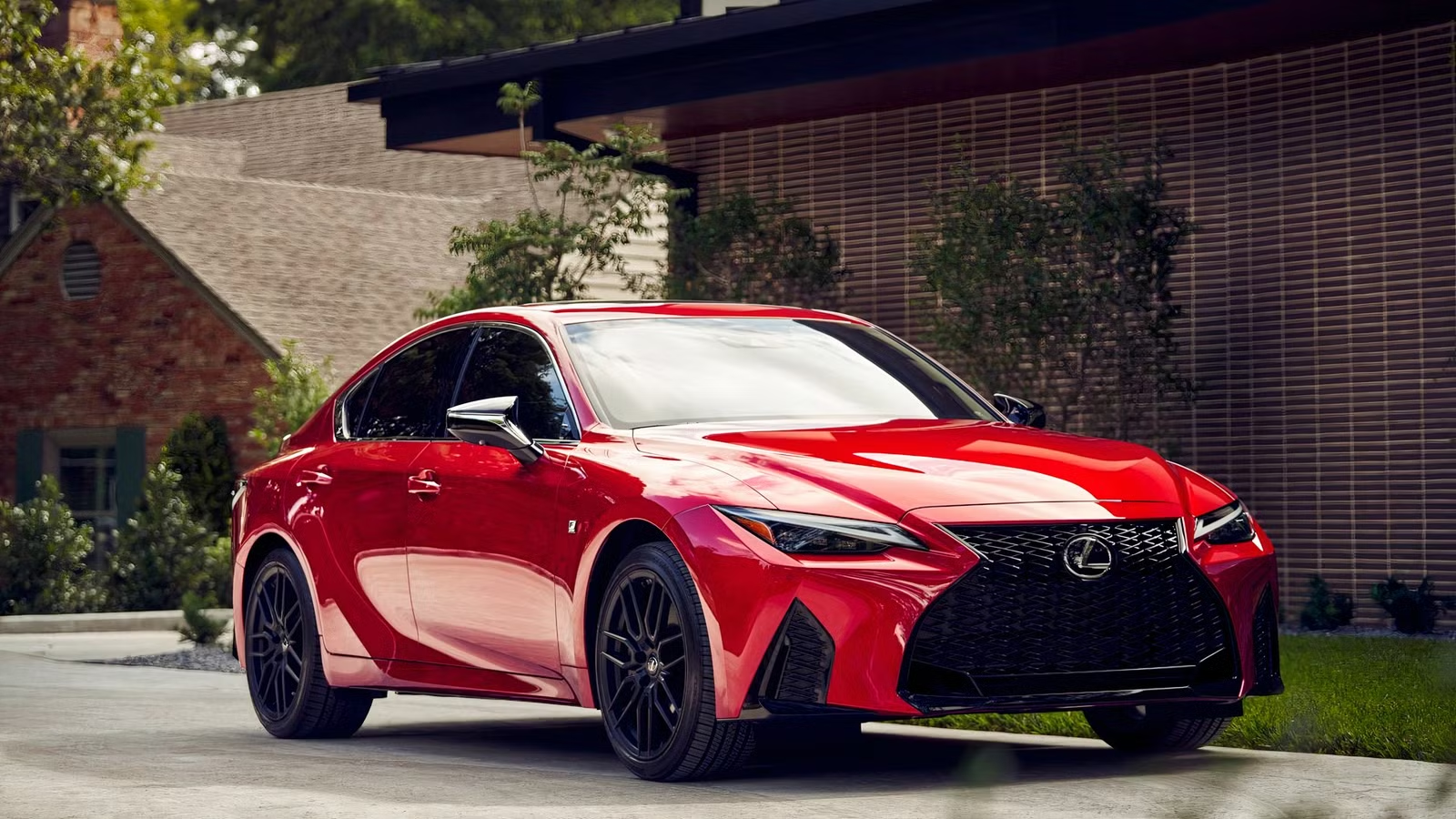
The Lexus IS remains one of the most dependable sports sedans in the luxury segment. For 2026, the only engine option is a naturally aspirated 3.5-liter V6 producing up to 311 horsepower.
Its sporty styling and balanced driving character help it compete against rivals such as the BMW 3 Series and Audi A5, while its long-running platform and proven powertrains continue to support excellent long-term reliability. Unlike some competitors that have become increasingly reliant on complicated electronics and downsized engines, the Lexus IS continues to prioritize dependable mechanical engineering.
Average Yearly Maintenance Cost: Around $540
Estimated Maintenance Cost During The First 10 Years: Around $6,000
Worst Year To Buy Used: 2007 (melting dashboard issues)
This ranking highlights a clear trend across the Lexus lineup. Proven platforms consistently outperform newer ones, while simpler powertrains generally deliver stronger long-term reliability. Lexus’ hybrid systems also remain among the most dependable electrified setups in the automotive industry. Even the lower-ranked Lexus models still perform strongly compared to many luxury rivals. If outright long-term dependability matters most, the Lexus ES and RX remain standout choices, while the GX continues to be one of the toughest SUVs in the range.
Newer vehicles such as the RZ and TX show strong potential, but they still need time to establish proven ownership records. In the end, Lexus doesn’t win by chasing trends — it wins by refining what already works.
Found an error? Send it info@www.topspeed.com so it can be corrected.
Sources: Lexus, J.D. Power, RepairPal, CarEdge.
Source: https://www.topspeed.com/ranked-most-reliable-lexus/
BMW
Every Lexus Model Ranked By Long-Term Reliability Score
Article Top Ad Zone
Article Middle Ad Zone
Article Bottom Ad Zone
Original Source: www.topspeed.com
Share
Comments
Comment system is currently disabled.